★★★★☆
The latest musical to premiere in Manchester is Bank of Dave The Musical, which is based on the book, documentary, and highly fictionalised Netflix film of the same name. The musical follows the eponymous Dave Fishwick, a self-made millionaire from Burnley who battles the financial systems to establish a local, ethical bank.
As a born-and-bred Burnley boy and theatre blogger, never in a million years did I expect there to be a stage show – let alone a musical – set in Burnley. Burnley’s own Sir Ian McKellen told me that, during the Second World War, Burnley unexpectedly became the theatre capital of the UK, when the Old Vic and Sadler’s Wells moved to Burnley to escape the London Blitz – but this is, sadly, forgotten history. Burnley is now a deprived post-industrial town (albeit with a surprisingly incredible coffee scene and “the best Italian café in the country”) so it’s not very musical theatre.
Bank of Dave has book and lyrics by Rob Madge and music and lyrics by Pippa Cleary, who previously collaborated on another autobiographical one-person-show: the absolutely acclaimed My Son’s a Queer (But what can you do?). It’s no surprise, then, that the score is sublime, filled with both ballads and bangers, three of which they previewed at the exclusive launch event last year. Some of the songs are even performed like pub singalongs. There are also references to famous pop hits and musical theatre classics, with the Act 1 closing number appearing to be inspired by ‘Do You Hear the People Sing?’ from Les Mis. The musical has clearly been written by people who know and love musical theatre.
The script is incredibly well-written, with bundles of Northern humour, some of which is a bit naughty, but it never feels crass. I do wonder, however, if the show should become more family-friendly, especially because of its focus on community and all of its important themes. The musical is not trying to reinvent the wheel; it’s a fun, feel-good extravaganza that preaches positivity.
The first act is a bit bloated in its second half, which could do with a bit of a trim. The show opened after only a few previews so I imagine the creatives are still working on it and will make some changes ahead of its opening night at Curve, where director Nikolai Foster is Artistic Director.
The characters are all so wonderfully and warmly written. Madge has taken archetypes and fleshed them out. They are camp and even melodramatic but still believable; it works for the whimsical tone of the piece that blurs fact and fiction. The musical could have easily become sappy and sentimental but Madge fills it with so much life and love.
It’s so refreshing to see Burnley portrayed positively. The general (classist) stereotype is challenged and subverted.
It is, however, a bit of a rosy, romantic image of Burnley. In actuality, there are real divisions and lots of issues, particularly with racism. It portrays the locals as a bunch of anti-Tory lefties but voter demographics have shifted noticeably with most working-class White people now supporting right-wing parties, as seen in the local elections, which took place on the same day as this premiere.
It’s a shame that only one of the (incospicuous) Burnley characters is South Asian (plus a brief appearance by a hijabi) when South Asians have such a strong presence in Burnley. The deuteragonist, Hugh, an out-of-touch, out-of-town lawyer, is played by a mixed-race South Asian actor, but the character is not written with an ethnicity in mind so race/ism is not explored here.
Furthermore, whilst the inclusion of a Cher-impersonating drag queen in the featured pub is lots of fun, Burnley does not actually have much of a drag scene; there might be a few niche events hosted by drag queens (such as Diana DoGood, who has experienced homophobia in Burnley) but one will not find a drag queen casually walking around and performing at a mainstream pub; that would be much too unsafe. A dude in a dress would possibly get the crap kicked out of him if he walked through Burnley town centre looking like that, sadly. Whilst the inclusion of a much-loved community drag queen makes for great entertainment, and feels very celebratory, it is sadly not reflective of the real Burnley and is, ultimately, a fantasy – but we can dream.
The Netflix film is only very loosely based on reality so the elements taken from that are mostly fictious. Sadly, Def Leppard never played Burnley! The musical includes the fictional fundraising concert but excludes Def Leppard; it instead seems like the busker headlines the concert, which is a nice evolution for the character. At the end, the musical becomes a bit meta, and reality and fiction are gently separated – whilst I understand the intention, and appreciate the honesty, which is reflective of such a down-to-earth show, it might not be as interesting and powerful as it thinks it is, but the final message is poignant.
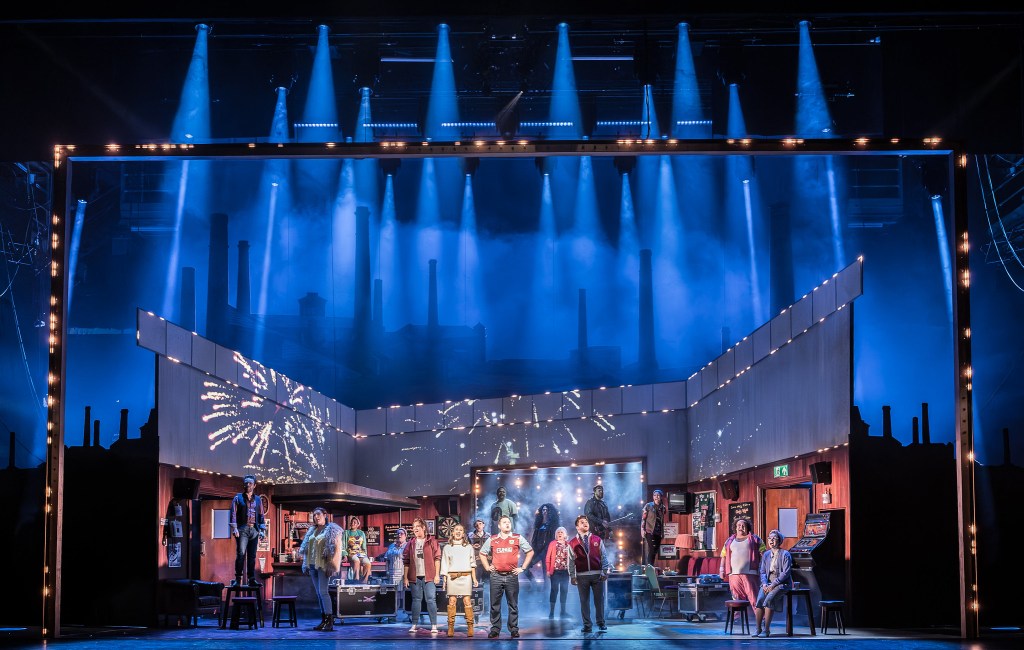
The creative side of the production is basically perfect. Amy Jane Cook’s set is a fixed pub, which is flawlessly transformed into countless locations, with a huge mill in the background, speaking to Burnley’s historic legacy, which literally looms over the present. The top of the walls have screens with varied video designs (Duncan McLean) which do everything from enhance a location to show flashbacks. Ben Cracknell’s lighting is warm and intimate, invoking a sense of community. Cook’s costumes capture the tone of the piece by feeling realistic but heightened. Ebony Molina’s energetic choreography cleverly combines musical theatre with more realistic movements. It’s a little rough around the edges, which allows the characters to feel more real.
Whilst the musical is set in a post-industrial town, it never feels drab. It’s full of life and charm and colour and exuberance. The production often verges on spectacle.
The casting direction by Harry Blummeanu CDG deserves particular praise. Whilst Jason Manford was initially announced to be playing Dave, the production instead opted for the person best for the role, rather than a star. Manford presumably opted for Something Rotten, which is having its international premiere in Manchester next month, over this; he previously starred in the West End concert version.
Sam Lupton not only masters the Burnley accent (much better than Rory Kinnear in the movie) but also completely transforms into the jolly, larger-than-life Dave. Hayley Tamaddon, stands her own as his proud partner, Nicky, who has been with Dave for 30 years. Her voice is divine.
As aforementioned, the charming Lucca Chadwick-Patel plays London lawyer Hugh, who goes on the biggest journey of all the characters. Lauryn Redding delivers another powerful performance as local doctor Alex whilst Joni Ayton-Kent brings a lot of heart and humour as her best friend, Megan, a hospital receptionist. Musical theatre veteran Claire Moore steals hearts as landlady Maureen, particularly in her solo number, where she reminisces about her late husband. Her adopted son, Danny, a soulful busker, is played by Zachary Willis, whose performance towards the end of the show is especially touching.
Samuel Holmes repeatedly steals the show as the villainous Sir Charles Denbigh as well as David H, with Mark Peachy and Hannah Nuttall getting a lot of laughs as drag-cop Cher and Dave’s secretary, Mavis, respectively. The incredible cast is rounded off with Rosie Strobel (Barbara), Minal Patel (Ali), Elliot Broadfoot (Omari), Althea Burey (Betty), and Jhanica Van Mook (Claire).
Bank of Dave is exactly the kind of musical we need right now: loud, proud, hopeful, and defiantly Northern. Its creative team delivers a polished, imaginative production with a score that already feels primed for cast recordings and cabaret nights. The writing is affectionate and funny, even if the narrative occasionally leans too heavily into mythmaking and soft-focus nostalgia. Representation remains an area for growth, especially given Burnley’s real demographics and social tensions. But the show’s heart, craft, and community spirit shine through. With some tightening and braver engagement with the town’s realities, it has the potential to become a modern British crowd-pleaser.
Bank of Dave The Musical runs at Lowry (Lyric Theatre), Salford until May 16 before transferring to Curve, Leicester from May 20 to 30.
Photo: Marc Brenner