★★★★☆
Manchester International Festival 2025 kicked off at the Royal Exchange Theatre with Liberation, a new play from writer Ntombizodwa Nyoni and director Monique Touko, tracing the private lives of activists who fought to liberate Africa – and marking 80 years since the Fifth Pan-African Congress in Manchester.
After being mugged days earlier, I was not in the mood for anything too serious. But whilst Liberation deals with a serious topic (and treats it with the dignity and respect it deserves), it does not take itself too seriously. A lot of race-based stories focus on trauma, rendering its characters victims, à la Blaxploitation and torture porn, but this play is not so much about racism and colonialism as it is the fight against it. Right from the get-go, our characters are not merely victims, not even just survivors, but active agents of change.
The dynamic play is surprisingly funny, with some real laugh-out-loud moments. It’s a jubilant celebration of Black joy and excellence. It stands out, alongside Lovecraft Country, as a piece of work that explores racial trauma whilst presenting its characters as full-rounded, nuanced, complicated, multifaceted people that are so much more than their trauma – and in spite of it. Indeed, even people facing hardships experience happiness and joy – or at least try to – and the characters here all have positive aspects to their lives, and we even see them dancing in a bar like nobody’s business. This is not rendered escapism from the horrors of real life; it is real life. “Dancing is a holy act to us Africans,” says one character.
Whilst it is an historical play, Nyoni strips back the facade to reveal the real people behind the often overlooked historical event. This eliminates any potential for a disconnect. We get to know these people; we care for them. It’s a clever narrative device, not too dissimilar from James Cameron focusing on (the fictional) Jack and Rose in Titanic – we have an anchor (pardon the pun) and are thus more invested.
Every single character is given attention and care. Every single character is complicated and flawed. Nyoni does not try to present these people as virtuous angels who can do no wrong. They’re not Mother Theresa – heck, even she did some wrong. Every single human being does wrong. But also, who gets to decide what is wrong? Some things are universally wrong, sure, but other things are far more complicated. Nyoni’s characters are good people but some of them do some questionable things and can be considered morally dubious.
There are various debates and discussions, and Nyoni does not tell us what to think; it never feels preachy or patronising. Rather, she explores these topics through her characters, who express different viewpoints. Black people are not a monolith. But nor are White people – and the play does not vilify White people. There are two White women who are passionate anti-racist activists, and whilst Betty Dorman (Bex Smith) is interrogated – even by the other White woman, Dorothy Pizer (Nicola Stephenson), who finds her ignorant and immature – she is never vilified, and I actually sympathised with her against the relentless attacks on her character. As the mixed-race Len Johnson (Tachia Newell) says, she is trying her best and learning everyday.
Len’s mixed-race identity is explored nicely and sensitively: how he is too Black for the Whites and too White for the Blacks. However, it was a missed opportunity to not see him confront the other Black characters about this, especially when Alma La Baddie (Leonie Elliott) criticised mixed-race relationships (this feels a little off though because Leonie is light-skinned). Alma makes a considered point about Black fathers leaving and White women raising Black babies that they cannot fully relate to or understand. It’s also interesting to see a White woman in a relationship with a Black man disproving of another White woman doing the same because she does not think that she is serious about the relationship.
Alma and Dorothy make disparaging remarks about Betty’s family potentially being racist – judging her even though they are supposedly opposed to prejudice. Hypocrisy is on full display – on another occasion, Amy, a divorcee, tells a male colleague that nobody judges him for having multiple wives.
There are even contentions between different regions of Africa. Still today, so many people talk about Africa as if it is a country – and some people even think it is one! – so it’s great to see this breakdown. We learn about some of the politics of those in the African diaspora. “West Africa is not the centre of the continent,” one character jokes.
Indeed, the intersectionality of the piece deserves great praise. Early on, Alma is dismissed not only by a White woman but also a Black man. Betty had not realised that Alma was a delegate, and she defends this by saying that there are 200 delegates – but Amy Ashwood Garvey (Pamela Nomvete) reminds her that only two of them are women.
There are contentions about idealism and solidarity, and some characters have personal ambitions that they arguably put above the greater cause – especially Kwame Nkrumah (Eric Kofi Abr), who is scolded even more brutally than Betty is, especially by his mentor, George Padmore (Eamonn Walker), who has his own problems, especially with how he treats and dismisses Kwame.
The nine-strong cast is rounded off with Rudolphe Mdlongwa (as Makumalo Hlubi), Tonderai Munyevu (as Jomo Kenyatta), and Joshua Roberts-Mensah (as Joe Appiah).
The production even has some meta elements, such as jokes about the press – on press night! The audience is addressed, making us stand in as the audience of the Congress. This eliminates the feeling of voyeurism; we are actively involved in the Congress. The meta elements, and desire for some audience participation, allows audiences to be responsive and celebratory. Whenever I see a Black show, Black audiences show up – and they often respond vocally and loudly. It was similar with the South Asian audience members at the recent premiere of Come Fall in Love, a stage musical adaptation of an iconic Bollywood film. Liberation is not here just to teach White people; it is of, by and for Black people.
However, the play is accessible and open to everyone. At one point, we are asked to chant “Ubuntu”, with the text displayed on a screen.
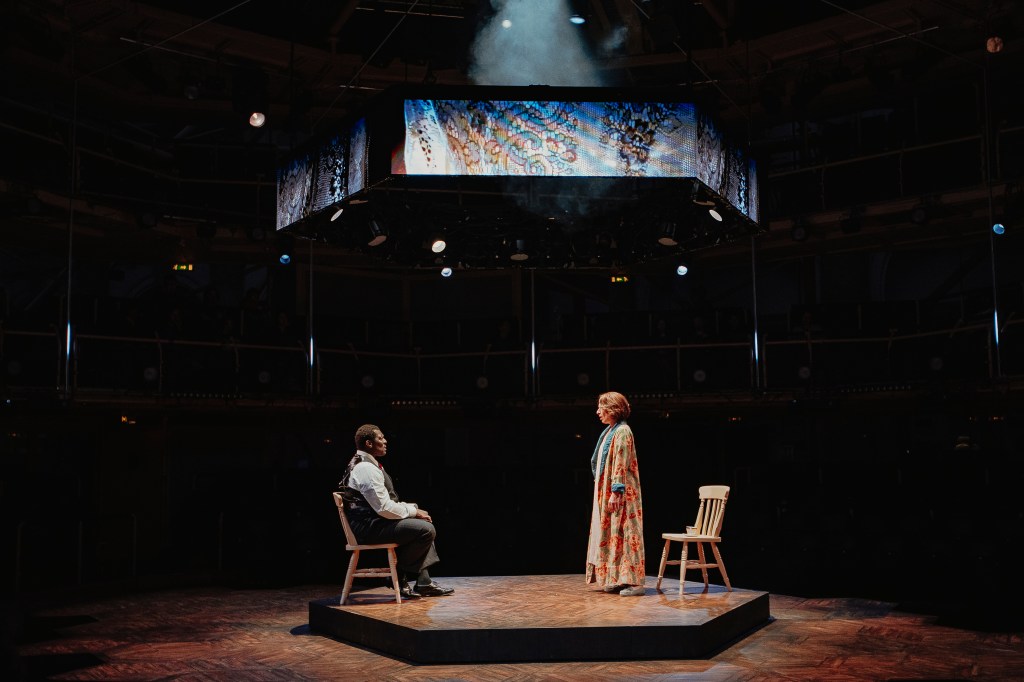
The squared screen – a cube with screens on each side – is used wonderfully, with beautiful video designs by Dick Straker. The stage (set design by Paul Wills), which appears to look like the African continent, is stunning, and the space is used wonderfully. Matt Haskins’ lighting reflects feelings and discussions, and the sound design (Alexandra Faye Braithwaite and Nick Lodge) is excellent. Ife Ogunjobi’s compositions are authentic and aurally delightful. Sunny Dolat’s costumes are period appropriate and stunning. There is lots of attention to detail, even in the costumes, e.g. Amy wearing bright red when she “transgresses” – a real 180 for her powerful, serious character – and even refers to a “scarlet letter”.
It is, without a doubt, one of the best designed productions I have seen at the Royal Exchange. It’s a heavy topic, with some real emotionally charged moments, and lots and lots of talking – but the dazzling design keeps you from feeling overwhelmed by the diligent dialogue.
Kloé Dean’s’s movement direction and Bethan Clark’s fight and intimacy direction deserve praise; even the most heightened emotions feel real and raw.
There are lots of tonal shifts in the play. It’s a real rollercoaster, reflecting life. Act 1 ends heavily but act 2 opens with culture and colour before getting really heavy.
The final photograph scene reminds us that these were real people and imprints their images into our memories. It’s very clever.
Liberation is, quite clearly, written and directed by Black women – because it has been written and directed with love and affection. It’s not polished, but it’s not trying to be. It’s a reflection of real life, and real life is messy. It could do with the odd narrative and directorial tweak before its next iteration, hopefully in London, but this play should be seen and celebrated by people all around the country. It has the potential to become a future classic. Indeed, at the post-show reception, Nyomi said, “All old plays were once new plays,” anticipating a bright future for this ground-breaking, monumental piece of theatre.
Liberation runs at the Royal Exchange Theatre until July 26.
Photo: Isha Shah Photography
 JADAR
JADAR 