★★☆☆☆
Whilst I’m getting a little tired of all the new plays and musicals based on movies, I was excited at the prospect of seeing a film noir brought to life onstage. Whilst Double Indemnity is directly based on James M. Cain’s novel of the same name, it visually references its iconic film adaptation. But sadly, it did not translate well to the stage, perhaps by virtue of trying too hard to be film noir.
The narrative follows Walter Neff, an insurance salesman who is seduced by the manipulative Phyllis Dietrichson into murdering her husband to collect on a fraudulent accident insurance policy. Whilst vamps and femme fatales might have had a feminist edge back in the day, because most female roles were boring and reductive, they feel a bit problematic today. Whilst the play is set in the 1940s, one would expect a 2020s production to make the narrative feel more relevant and speak a more strongly to today. The ending, by swapping who dies, is perhaps trying to do something a little feminist but only if you really think about it and interpret it that way.
The first act is incredibly drawn out. It’s trying to be a slow-burn but it hardly even sizzles. Things pick up considerably in the second act, and the writing feels less clunky and unnatural, but it never grips you in the way that a thriller should. It’s lacking in intrigue and suspence, in no small part because it never gets you to care; there is no emotional investment demanded from the audience.
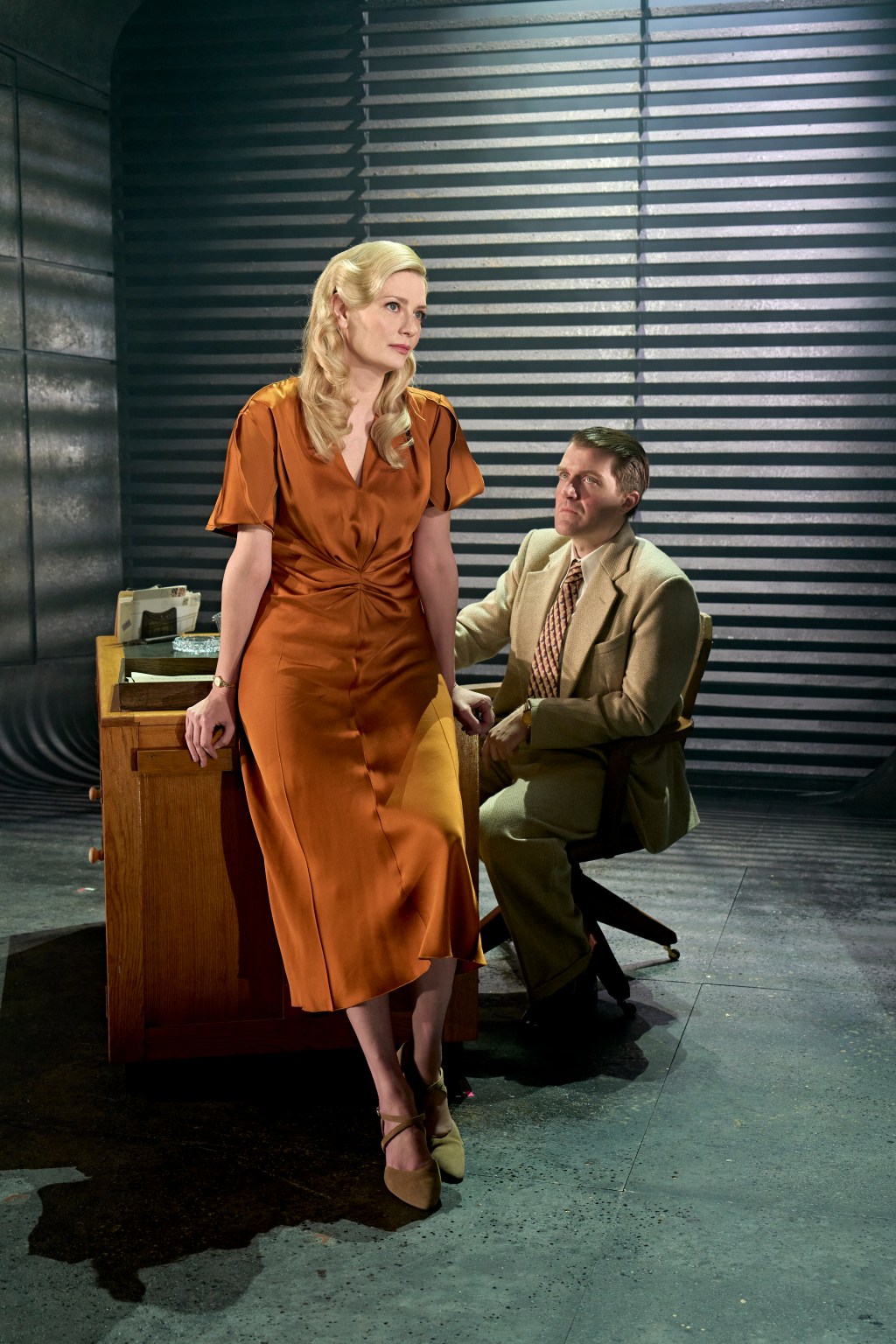
The static set is rather pedestrian. It looked good in the sketch but in real life it feels boring. On a couple of occasions, the walls open (you know the set is far too simple when you’re excited by a few panels being removed). There are a few huge letters at the top of the stage which apparently reference the “HOLLYWOOD” sign, which appears in between scenes in the film. Locating the action directly underneath the sign feels a bit on the nose but it might be meta commentary; the opening and closing scenes directly address the audience, which is an interesting narrative device, but it is never fully realised.
The lighting and smoke successfully transform the stage into an atmospheric film noir but it is just too dull and gloomy. It’s monotonous, and you feel detatched from the action. The production tries too hard to be a film noir, which works in theory but not so much in practice; theatre requires more oomph and dazzle.
Similarly, Mischa Barton’s performance does not work onstage; she is clearly a screen actor, and this feels more obvious when pairing her with such a strong stage actor like Ciarán Owens (who I recently interviewed alongside Kit Harington at the premiere of Psychopomp, in which Owens plays a hitman – he’s got a type!), with whom she lacks chemistry. Barton seems to be honouring Barbara Stanwyck’s performance in the film, where Phyllis is often quite static and acts unnaturally around her husband, but onstage this feels wooden. She should have been directed to be more camp, glam and seductive, which would have made Walter’s infatuation with her make more sense; the audience would better understand how a decent man was seduced into murder.
The best performance comes from Martin Marquez, who chews up the scenery and leaves no crumbs. It’s not great when the movie star is outshone not only by their love interest but also a supporting cast member. Several actors multirole but the characters are not always distinguishable, which can make things a little confusing.
There is a real missed opportunity in not doing something more interesting with this story. There is some meta commenary and an element of self-awareness but it could have boldly satirised film noir and its conventions and clichés. Whilst it has brought a film noir to life onstage, it could have deconstructed it, with cameras and screens – and whilst that theatre device is becoming overused, it could work incredibly well with the narrative and themes of Double Indemnity – especially a self-aware, feminist Double Indemnity.
Double Indemnity, as it is, has real potential that is not fully realised and is disappointingly staged.
Double Indemnity runs at Opera House Manchester until May 2 before finishing its UK tour at New Theatre, Cardiff from May 5 to 9.
Photo: Manuel Harlan

