★★★☆☆
A brand new comedy play co-commissioned by Lowry and co-produced by Royal & Derngate Northampton and The Wardrobe Ensemble, Party Season has arrived at Salford’s Lowry. Three five-year-old birthday parties. One Dad. One weekend. Will he make it through to Monday?
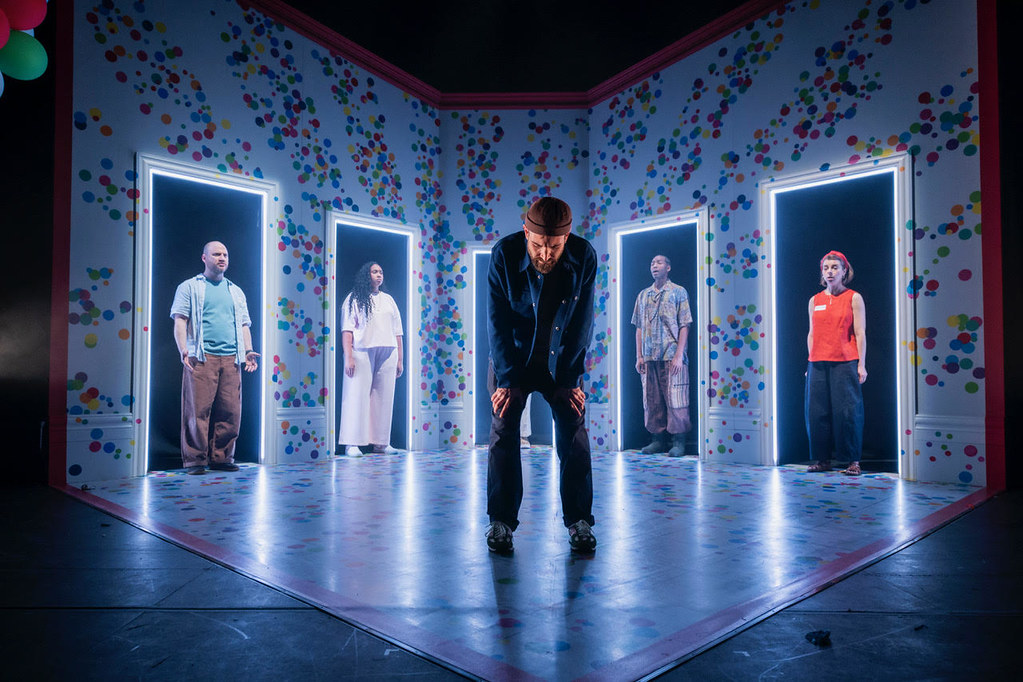
Devised by The Wardrobe Ensemble, Party Season is co-directed by Royal & Derngate’s Artistic Director and Wardrobe Ensemble founding member Jesse Jones (Top Gs Like Me, Breaking the Code) alongside The Wardrobe Ensemble’s Helena Middleton (Mog’s Christmas, Royal & Derngate). The action unfolds across a rainbow polka-dot explosion of a set, designed by Bronia Housman, illuminated through five entryways with balloons hanging overhead, immediately plunging the audience into the chaos of a children’s party.
Amongst the polkadots is young father Xander (Tom England), left to survive a weekend of children’s birthday parties while his wife is away at a conference. Alongside his nervous five-year-old son, Felix (James Newton), Xander attempts to navigate three children’s birthday parties in one weekend, a premise nightmarish enough on its own, while also confronting grief, fatherhood, and the dreaded class WhatsApp group.
As the weekend rolls on, snippets of Xander’s relationship with his deceased father, formerly a plasterer and part-time party entertainer, emerge through a descent of birthday party-themed gags. Shame becomes a central thread, tied closely to masculinity and self-expression. Xander’s embarrassment towards his father’s enthusiasm for magic and entertainment is mirrored in the way he later treats his own young son, appearing ashamed of Felix’s emotional outbursts and passion for magic tricks.
The physical elements are often the production’s strongest feature. The physicality of the actors portraying children is especially memorable: performers crouch on their knees before suddenly flailing into movement, creating uncanny exaggerated child-people. The performances overall are energetic and tightly directed, maintaining momentum even when the writing slows. Sharp bursts of light lining the doorways, alongside cartoonish sound effects, further intensify The Wardrobe Ensemble’s playful direction. Jacade Simpson (Kane and Aonghus) is particularly diverting; his fluid, wacky physicality consistently draws attention and laughter from the wider ensemble.
Yet the production struggles to build a strong enough emotional arc. Scenes drift, overall pacing remains sluggish, and there is an ongoing sense that the material may not fully justify a full-length 90-minute runtime. One particularly poignant moment arises through Simone (Kerry Lovell), a woman experiencing postpartum depression who appears throughout the show in various doorways as a ghostly “girl in the ring” figure, her long hair obscuring her face as haunting music swells around her entrances. In a striking shift in tone, Simone hands over her baby, drinks cider, and recites hopeful poetry about caterpillars, signalling rebirth and freedom. While visually and emotionally beautiful, the moment feels unexpectedly detached from the rest of the production and ultimately not enough to sharpen the play’s structure, sitting somewhat incongruously against the otherwise linear narrative and bubblegum tone of the piece.
One of the more interesting, though frustrating, aspects of the play is its portrayal of domestic labour. Xander is, in many ways, portrayed as a bad father, though the narrative repeatedly softens this by framing him as merely awkward and trying his best. Nevertheless, he ultimately comes across as unlikeable, which becomes particularly trying given he remains the centrepoint of the narrative. Meanwhile, Xander’s wife exists largely through phone-call asides, despite it being obvious that she carries the majority of the family workload, due to Xander’s incompetence. The play gestures towards the invisible labour women disproportionately perform in heterosexual households, reflecting broader realities around childcare and housework, but never fully interrogates this imbalance. Instead, it often pokes fun at it before ultimately allowing Xander to coast along, relying on the other parents in the WhatsApp group to pick up the pieces. What initially feels like it may develop into a sharper critique is ultimately swept aside in a more apologetic register.
Party Season eventually comes to a head through a conflict within the WhatsApp group, though the conclusion lands with an anticlimactic halt. The production contains strong ideas and inventive theatrical moments, but despite flashes of insight and sustained energy from the brilliant cast, it never quite develops enough momentum, nor fully ties together its larger ideas surrounding fatherhood and the disproportionate parental labour.
Party Season runs at Lowry (Quays Theatre) until May 16 before ending its UK tour at Bristol Old Vic from May 21 to 23.
Photo: © Paul Blakemore

