★★★★☆
The English National Opera has kicked off its move to Manchester with the UK premiere of the Pultizer Prize-winning modern opera Angel’s Bone, in collaboration with Factory International and BBC Philharmonic.
Angel’s Bone follows the plight of two angels forced into spiritual and sexual slavery by a desperate couple who find them injured in their garden. It is, essentially, a contemporary parable exploring modern-day slavery and human trafficking, humanising the “creatures” (predators often dehumanise their victims to justify torturing them) but also the predators (not to justify their actions but to help the audience understand their psyche and how seemingly ordinary people, who we see in such a domestic setting, can be driven to exploit what they themselves call “innocent creatures”).
Angel’s Bone is an opera for the modern age. Its story of cruelty is pertinent, feeling even more relevant today, as the world reckons with the Epstein abuse scandal but also in the aftermath of Reform dominating the UK’s local elections last week. The creatives, then, have made this production as accessible as possible, though still incredibly artistic and as avante-garde as one would expect from Factory International – but whilst Factory’s productions can sometimes be a bit alienatingly avante-garde, this production is accessible and entirely engrossing.
Royce Vavrek’s libretto is straightforward and easy to follow. Du Yun’s compositions, sung in English with English surtitles, operate in a liminal space between traditional and contemporary, seamlessly fusing opera with modern music genres, with a couple of later songs going full electronic, the beautiful, classical score dramatically transforming, perhaps symbolising the corruption of innocence and the breakdown of the angels.
Du Yun has thrown out the rule book, honouring opera but refusing to stick with all of its conventions, thus challenging the status quo. The end-result feels like Björk has created an opera at a rave. At its most maximalist moments, it might remind you of Björk and Rosalía’s BRITS performance of ‘Berghain’, which has been acclaimed for its ambitious, experimental blend of pop, orchestral and classical music – with the BRITS performance rapidly shifting from its grandiose, classical arrangement into an uptempo, hard-hitting techno and “donk” beat. The track belongs to Rosalía’s album, LUX, which explores lyrical themes of feminine mystique, transformation, and spirituality, with its songs inspired by the lives of various female saints, as well as Rosalía’s relationship with God, hence the church-like, Latin elements. Angel’s Bone, similarly, has religious themes, with the couple even using religion to justify their actions, which references a long-standing history of religion being used as a tool to oppress (e.g. the transatlantic slave trade) but also a means to make people feel better about being terrible people.
The production is directed by Kip Williams, who is known for his bold “cine-theatre” productions, such as the critically acclaimed The Portrait of Dorian Gray, starring Sarah Snook, and the more divisive Dracula, starring Cynthia Erivo, which is currently on the West End.
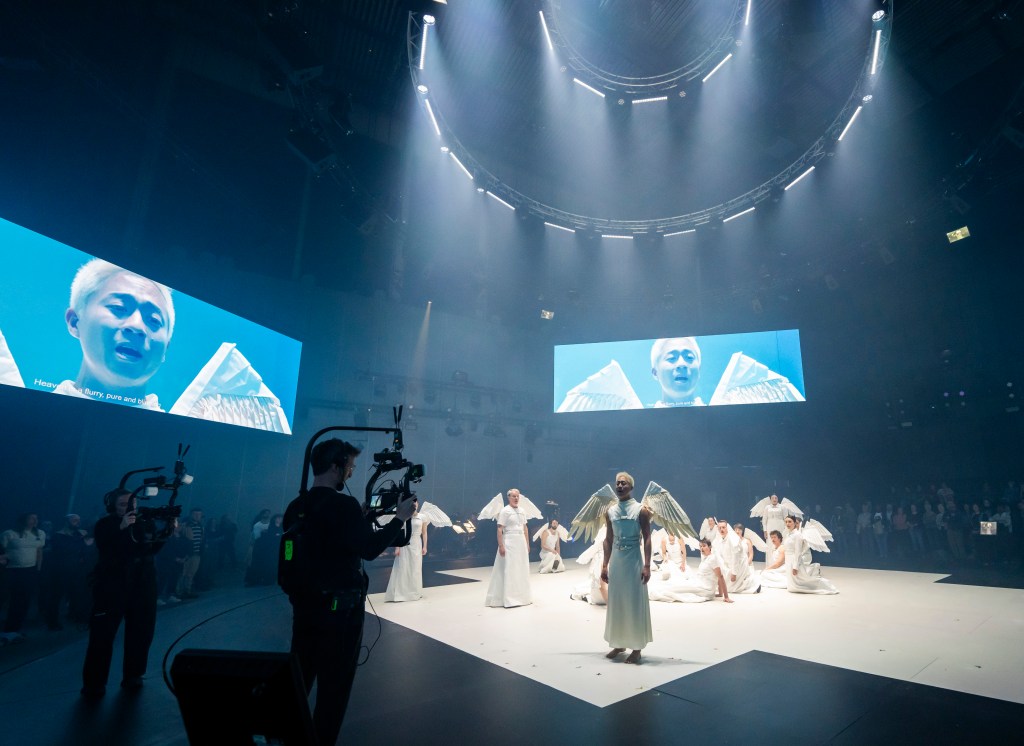
Taking place in Aviva Studios’ versatile, and often unrecognisable, Warehouse, the production is performed on a massive, revolving, circular stage, with the audience stood around and a few seats at each side for people with access and additional needs. The low stage will make it tricky for shorter people to see if they have taller people stood in front of them. The audience do not move around so the production probably could have just had seats.
Whilst it could be more exciting if the audience got to move around, people would gravitate towards the performer singing at the time, which is not what this production wants; it wants us to appreciate all the little scenes and watch the performers (recorded live by camera operators) on one of the huge four screens. Whilst this is innovative and exciting, it results in an impenetrable barrier, which can feel dizzying, disorienting and even emotionally distancing, especially if you are stood at the back and thus only catch glimpses of each scene as they glide past you. Occasionally, the set partially obscures the screens, which feels counterproductive. Sometimes you see something very exciting happening onscreen and wish that scene had taken place in front of you. I wonder if it might have worked better if the stage spun faster at these intense moments, so that the room is literally spinning, but also allowing more people to see them in real life.
Whilst the production begins with the two angels sat and huddled together in the centre of the immense, empty stage, which drowns them, the stage is gradually filled with Marg Horwell’s epic set. It’s extraordinary watching a whole house be built before our eyes, imprisoning the angels and literally walling the audience out. Eventually, the angels are hidden from the audience’s eyes; we can only see them onscreen, which creates a feeling of eagerness and desperation to see something which we, in real life, cannot see; there is something voyeuristic about this, forcing us to reckon with our own desires and asking us what we would do if we were in the position of the cash-strapped couple or their curious guests, who are dressed ridiculously lavish (costume design by Horwell) for a mere house party.
Jack Knowles’ white lighting feels both angelic and clinical, referencing the entrapment of the angels, who are tortured in a bath, and who the couple argue would be subjected to medical experiments if they were handed over to the authorities. The lighting ranges from intimate to intense, enhancing the emotions.
The cast is led by Allison Cook as Mrs XE, a monstrous woman who could win an Olympic Gold Medal for her mental gymnastics, yet you cannot help but feel for her, if only because she is so desperate for love and attention and something more than dull domesticity; she wants to be “legendary”. She repeatedly changes her look, appearing unrecognisable at the end of the show, which speaks to the desire to reinvent oneself but also artifice in contrast to the angels’ natural beauty, which her and her husband corrupt and destroy – literally.
Her husband, Mr XE, is more morally dubious, which Rodney Earl Clarke succeeds in drawing attention to with his broken performance. Matthew McKinney is especially angelic as Boy Angel, who is actually subjected to more sexual abuse, whilst the iconic Mariam Wallentin has a quiet poise as Girl Angel, her wings brutally destroyed (that scene is incredibly disturbing) but her invisible halo still glowing.
The core cast is completed by Keith Pun as Male Soprano, who stalks the stage as an elegant angel, with the Kantos Chamber Choir beginning the show as a chorus of angels before transforming into cruel, sadistic party guests and, later, sycophantic fans of Mrs XE.
Angel’s Bone is simultaneously unsettling, harrowing, frenetic and angelic. This production takes an innovative, uncompromising, maximalist approach to the text and subject matter at hand, intentionally emotionally overloading its audience.
Angel’s Bone will transfer to the opulent London Coliseum in October with the same cast and creatives save for the ENO orchestra in place of the BBC Philharmonic. It will use the same circular stage but place it behind the proscenium arch. It will have to be completely redirected and restaged. So much of the appeal of this production comes from how immersive it is, and how, depending on where you are stood, you will have a noticeably different experience; it’s a shame that the London production will probably not be as bold and innovative, however, at least there will be no sightline issues.
Angel’s Bone runs at Factory International (The Warehouse) until May 16 and London Coliseum from October 16 to 31.
Photo: ©Tristram Kenton
 JADAR
JADAR 