Manchester International Festival 2025 kicked off with a bunch of press previews for their visual arts events.
First, let me clarify that I am not an arts writer. I primarily review theatre, and have done for seven years, as well as some music. I occasionally review exhibitions and experiences but seldom do I review visual art. Whilst I could write first-class essays on theatre, I don’t have the breadth of knowledge, critical analysis and impressive vocabulary of an arts critic – but what you get in this review is the honest thoughts of a novice.

Football City, Art United.
★★★☆☆
The day began in The Social at Aviva Studios, with speeches by Artistic Director and Chief Executive John McGrath and Creative Director Low Kee Hong.
We then heard from the curators of Football City, Art United.: Serpentine Galleries Artistic Director Hans Ulrich Obrist; footballer Juan Mata; and curator, writer and filmmaker Josh Willdigg. Obrist told us that he had been told that a very famous footballer followed him on Instagram; Mata loves art, especially Hans’ work, and they soon began working on this project. Also in attendance was footballer Edgar Davids, who had also appeared at the MIF launch earlier this year. Mata, himself, attended the visual arts day at the last MIF, two years ago, when the project began.
In Football City. Art United., an artist is paired with a footballer Ryan Gander and Eric Cantona; Paul Pfeiffer and Edgar Davids; Rose Wylie and Lotte Wubben-Moy; Keiken and Ella Toone; Stefano Boeri, Sandro Mazzalo and Eduardo Terrazas; Jill Mulleady and Diego Maradona; Chikyuu No Osakana Ponchan and Shinji Kagawa; Phillipe Parreno, Perego and Zoe Saldaña; Suzanne Lacy, Vivianne Miedema and Ali Riley; Alvaro Barrington and Raí; Barbara Sánchez-Kane and Jorge Campos.
At this year’s festival, The Playmaker by Stefano Boeri Architetti brings the spirit of football legend Sandro Mazzola to life.
The Playmaker consists of three cylindrical models, where people can move freely. There are circular holes of various sizes in the walls. Visitors can pass through them. Graphic patterns by Mexican artist Eduardo Terrazas cover the floors, with Prema Mehta’s lighting turning the exhibit into a bit of a theatrical experience. Before entering the main space, guests walk through a dimly lit corridor with loud football cheering; it’s very intense – but it sets itself up as a thrilling, immersive experience, which it is not.
Architetti saw saw Mazzalo not simply as a footballer but an artist whose play had vision and instinct. This installation reflects that; football is not just a sport but an art form.
The experience becomes more interesting upon finding out this information, but without it, it feels a little flat. The other pieces all feel a bit random. Like, what’s the purpose of that weird mask?
The lack of text explaining them is possibly an attempt to be more accessible, allowing visitors to interpret them how they see fit, but this ironically makes them inaccessible to some people who feel lost and confused.
It’s a refreshing fusion of art and sport – and perhaps sport is an art form.
Football City, Art United. runs at Aviva Studios (North Warehouse) until August 24 2025.
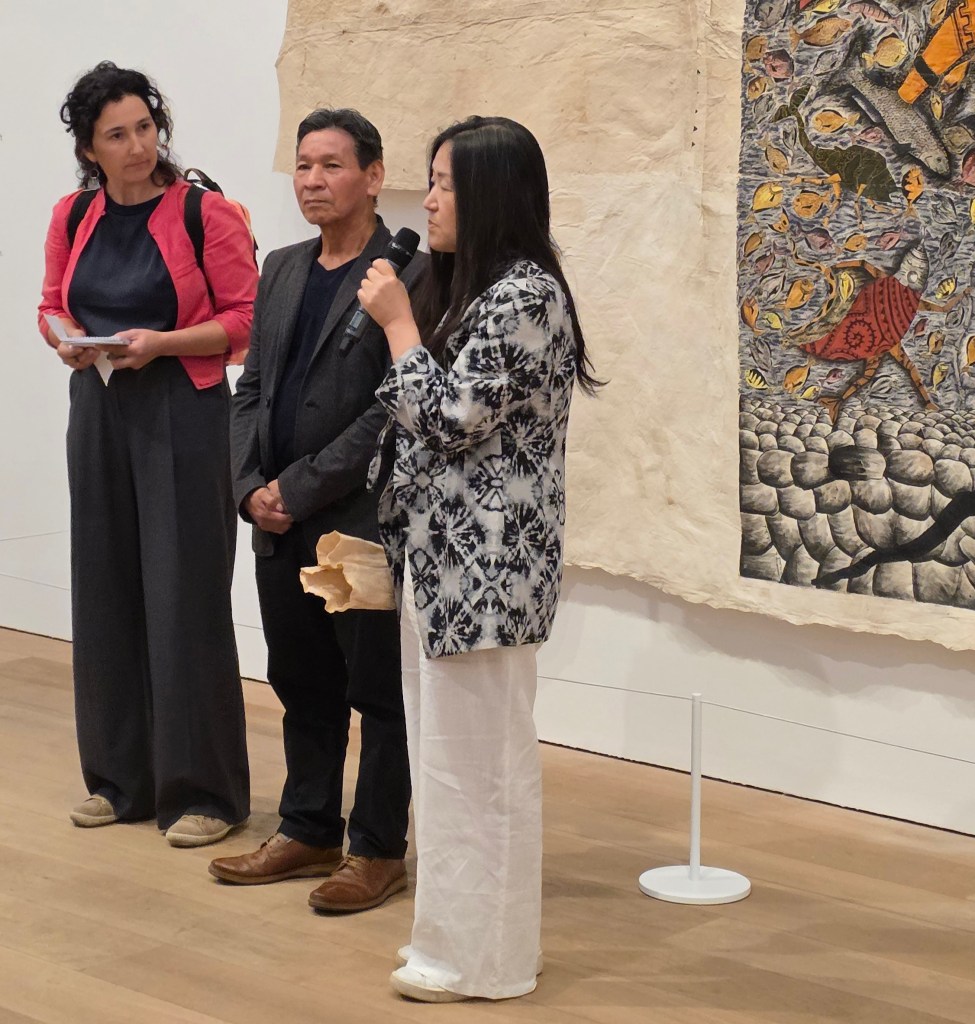
Santiago Yahuarcani: The Beginning of Knowledge
★★★★★
We were then transported to the Whitworth for lunch and the first international solo exhibition of works by Santiago Yahuarcani – artist, Indigenous activist and leader of the Aimeni (White Heron) clan of the Uitoto people.
There were speeches by, presumably, the curator, as well as Yahuarcani himself, with a translator translating his words from Spanish to English – though there were some Spanish speakers in attendance. The speeches went on for a little too long though I appreciate a lot of it was necessary repetition (Spanish to English).
Yahuarcani works in a remote Amazonian town in northern Peru. He creates large-scale, narrative rich paintings which explore the relationship between the Uitoto people and the natural world. Yahuarcani uses natural pigments and materials. He harnesses the memories, history and wisdom of his ancestors, the sacred knowledge of medicinal plants, the sounds of the jungle, and Uitoto myths that explain the multiple configurations of the universe.
I often say that all art is political; if it’s not political, it’s not art. Yahuarcani’s painting is a form of activism, protest and education; it is equally enticing and edifying.
Yahuarcani’s works are so rich, deep and powerful. You could stare at each painting for ages and constantly be noticing and picking out new things. Whilst Yahuarcani, of course, has his own ideas, the death of the author (or, in this case, artist) allows visitors to interpret things how they see fit – and Yahuarcani’s works allow for endless interpretations.
Santiago Yahuarcani: The Beginning of Knowledge runs at The Whitworth until January 4 2026.
Katie and I sadly did not get chance to attend any of the other press previews as we had to catch the train to see Train! However, I will be visiting FALE SĀ / SACRED HOUSE Exhibition tomorrow, ahead of the press night for FALE SĀ / SACRED HOUSE – SAUNIGA (Ceremony).
Manchester International Festival runs until July 20.
 JADAR
JADAR 