★★★★☆
Carlos Acosta’s Carmen is a modern reimagining of Bizet’s classic opera, instead interpreting the story through a ballet lens. The story follows Don Jośe (Alejandro Silva), a passionate and obsessive soldier who falls head over heels for Carmen (Amisaday Naara). After Carmen spurns his love for toreador Escamillo (Paul Brando), Don Jośe swears to enact his violent revenge.
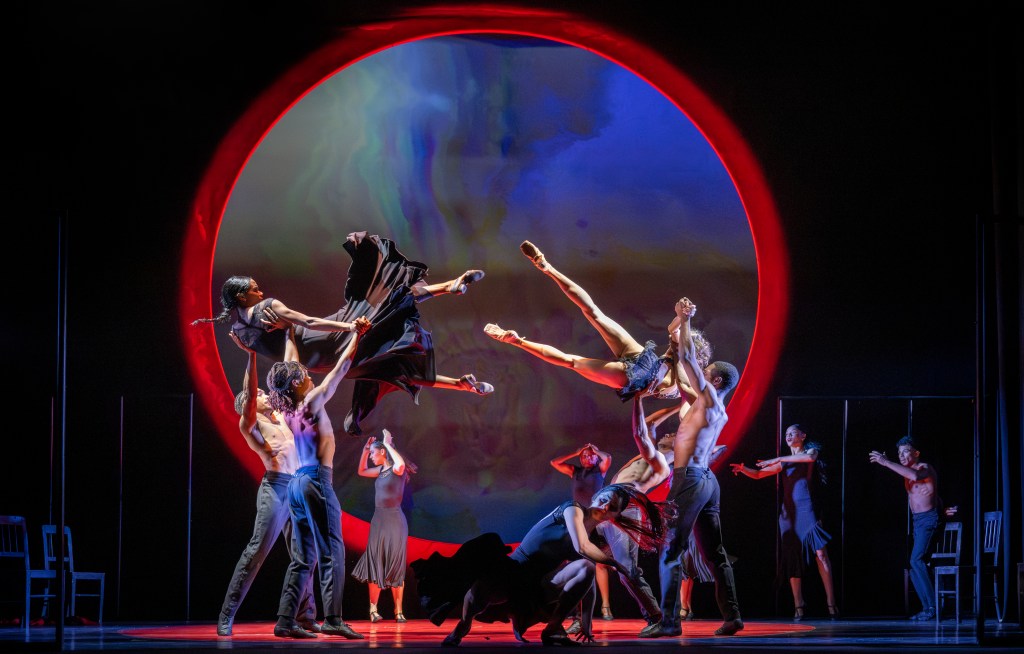
Carlos Acosta’s choreography is exquisite. He blends classical and contemporary ballet with energetic Cuban folk to create awe-inspiring, extravagant routines. Naara is a captivating Carmen, constantly oscillating between playfully seductive, powerful dominance, and angelic serenity.
Initially, Carmen is coy, carefree and beguiling, her commanding stance and quick-footed struts highlighting her effortless sovereignty over Don Jośe. Even when she’s bound in her prison cell, she reverses the dynamic, slowly entangling Don Jośe in a web of ropes to reassert her sexual command. In the translation to ballet, some of the subtlety of Carmen’s character has been lost, opting for a much more potent, sexually charged physicality to express her control. Even her costume echoes this, her flamenco-inspired crimson dress ripped away to reveal a risqué lacy black bodysuit.
Silva is equally captivating as Don Jośe, boundless acrobatic leaps and passionate embraces superseded by manic yearning and irritability as he’s met with Carmen’s enraged retaliation.
Don Jośe and Carmen’s routines are classically inspired, gorgeously poised frames sweeping effortlessly into swirling lifts- it’s one of these shows most breathtaking moments of choreography. Here, their embraces are led by him, a short-lived dynamic that Carmen refuses to stick to. In contrast, her dances with Escamillo are intoxicating, their bodies melting together with sexual tension and contemporary stylisation.
Bizet’s breathtaking score remains largely intact (minus the libretto of course), with new compositions from Martin Yates, Yhovani Duarte and Denis Paralta added to the mix. At times, the score feels a little at odds with itself, the majority of the first act sticking with the traditional score before an exciting Cuban infusion at the tavern. Saying that, I appreciated how the contrast bolstered Escamillo’s grand entrance, his bravado mirrored by energetic injections of Cuban folk. Similarly, the rest of the cast united in a thrilling, mostly synchronised folky routine, complete with cheeky drunken escapades.
Tom Hatley’s set values minimalism, a circular backdrop featuring various colourful contextual projections by PixelLux and Nina Dunn. Other times the stage is drenched in Peter Mumford’s vibrant lighting with particularly striking crimson reds. The occasional prop or barred structure makes its way onto stage but the dancers, music and a moody ambience take centre stage. Unlike the opera, the setting is atemporal and ambiguous.
In terms of the story, the ballet is largely the same, removing some beats for brevity and adding a couple for impact. The biggest addition is the bull (Aniel Pazos), who looks menacingly over the action. The bull acts as a metaphor for fate and a reflection of Don Jośe’s masculine rage. He orchestrates each scene, opening with Carmen’s tragic fate before lifting her like a mannequin and posing the pair for their scenes. Later, he breaks into her story, chasing, fighting and stabbing her in a dramatic parallel to Don Jośe (albeit an amusing one ending with his horns falling off). The imagery is fascinating but I’m not entirely convinced that the character added that much to the story outside of his striking visual presence.
Admittedly, the show is a little complicated from time to time, supplementing vocal storytelling with interpretive dance. Without prior knowledge of the opera, I do wonder whether I would have struggled to follow the story. Saying that, there are multiple alterations to the opera’s story that significantly impact the audience’s impression of Carmen as a character. Aside from her more overt proclivity, this production definitely leans into her portrayal as a traitorous cheat rather than an independent and sexually free woman. Here, she’s devious, luring Don Jośe and accepting his proposal before cheating, throwing his ring and attacking him. Her death still isn’t justified but the new proposal element and added cruelty provide little room for pity, making it less of a tragedy in her final moments despite the evocative visuals.
Carlos Acosta’s Carmen is poised, passionate, and powerful with stylish staging and enrapturing choreography. It’s an imaginative interpretation with energetic infusions and bold direction. However, there are some niggles with some of the story alterations feeling redundant and some beats becoming lost in translation. Regardless, it’s a fresh and entertaining rendition of the classic tale.
Carlos Acosta’s Carmen runs at Opera House Manchester until April 25 and tours the UK until May 9.
Photo: Katja Ogrin

