★★★★☆
Even These Things is a brand-new Irish-Mancunian play marking 30 years since an IRA bomb devastated Manchester and destroyed the Royal Exchange Theatre – where it is performed – with the final performance taking place on the anniversary.
Whilst there is no interval, Even These Things is essentially a three-act play, made up of three distinct stories, each with their own genre/style: a monologue; a narrative; and a conversation. They are set in 1846, 1996, and 2026, but all explore the relationship between Ireland and Manchester, and the Irish history of Manchester.
The first, a monologue – expertly performed by Elaine Cassidy, who quickly recovered every time she stumbled on her lines – follows an Irish immigrant who seeks to avenge her beloved pet pig. She stands on a bare stage and repeatedly turns to face everyone in the in-the-round theatre yet completely commands the audience. The visceral writing (Rory Mullarkey), the pungent performance and the fervent direction (James Macdonald) come together to make for a powerful, emotionally intelligent monologue which takes the audience on an emotional rollercoaster. It is darkly humorous right until the final moments, when it suddenly comes crashing down to the ground, as does Cassidy.
Whilst it is an excellent standalone piece, with references to 19th century Irish immigration, it is unclear exactly what it is trying to set up (unlike the third act, which feels very much like a follow-up to the second, whilst the third just has a brief, funny reference to the first).
The second act is first narrated by Katherine Pearce who later hands her notebook to Cassidy. I’m not sure why exactly this happened – perhaps it is to reference the Irish history of the town or to express unity between the Mancs and the Irish in spite of horror.
This act is about the lead up to and aftermath of the IRA attack on Manchester in 1996, which followed another IRA attack on Manchester a few years earlier and other IRA attacks around the UK – but this was the worst British bombing since the Blitz, which had also hit the Royal Exchange. The play might have made more direct reference to the theatre being hit by the IRA bomb, which would have made it even more powerful, for we were sitting in a building which was hit by that bomb.
The majority of the piece follows various random people around Manchester, with countless references to different parts of the city. The city is brought to life onstage, and we are thrust into the action. The members of the community are played by real members of the community from all 10 of Greater Manchester’s boroughs, with two casts of 54 alternating performances. This makes it feel even more real and raw.
It was nice to see some of the characters reappear. It made you care about them more more. Several of the most memorable characters were seen at the red telephone box, trying to reach their loved ones, prior to the bomb exploding but knowing that something is wrong, as the city centre had been cordoned off (the play neglected to mention that the IRA had given warning, which is why the authorities expertly evacuated the city, resulting in no lives lost).
On press night, the four girls appearing in Afflecks were played by Black girls. Whilst it was nice to see Black goths, the comment about the place smelling of weed suddenly felt racially problematic. Generally, however, the characters, albeit only appearing briefly, were written with love and affection. There is a group of four youths, of different ethnicities, planning to commit robbery; one later appears at the phone box, trying to reach a loved one, whilst the other three are seen supporting an elderly woman. These youths are not necessarily the same characters, even though they are played by the same people, in the same clothing, but it is nice to see a positive portrayal of young people.
Perhaps the two best scenes featured actor Fionnuala Dorrity, who twice descended from the heavens, as both the iconic Queen Victoria statue in Piccadilly Gardens and the police officer in a helicopter who spots the suspicious van in which the bomb was planted – with tiny vehicles below, touchingly and hilariously allowing the audience to see the city from her perspective.
The attention to detail in the script, the direction and the design (Laura Hopkins) is divine, from the 90s references to the 90s fashion. There is too much for one person to notice everything, from a Woolworths bag to the audience being told that a man is listening to ‘Zombie’ by Irish band The Cranberries, which the late lead singer Dolores O’Riordan wrote after an IRA attack killed two young boys in Warrington, Cheshire, which is not far from Manchester (this felt like foreshadowing).
Similarly to the first act, whilst much of the narrative is humorous, everything is shattered, literally, with the explosion making me jump out of my skin. The lighting (Charles Balfour) and sound (Ian Dickinson), artistic throughout, are utilised especially well here. The play cleverly shows how unexpected this attack was, and how ordinary people, just going about their day, were impacted and affected.
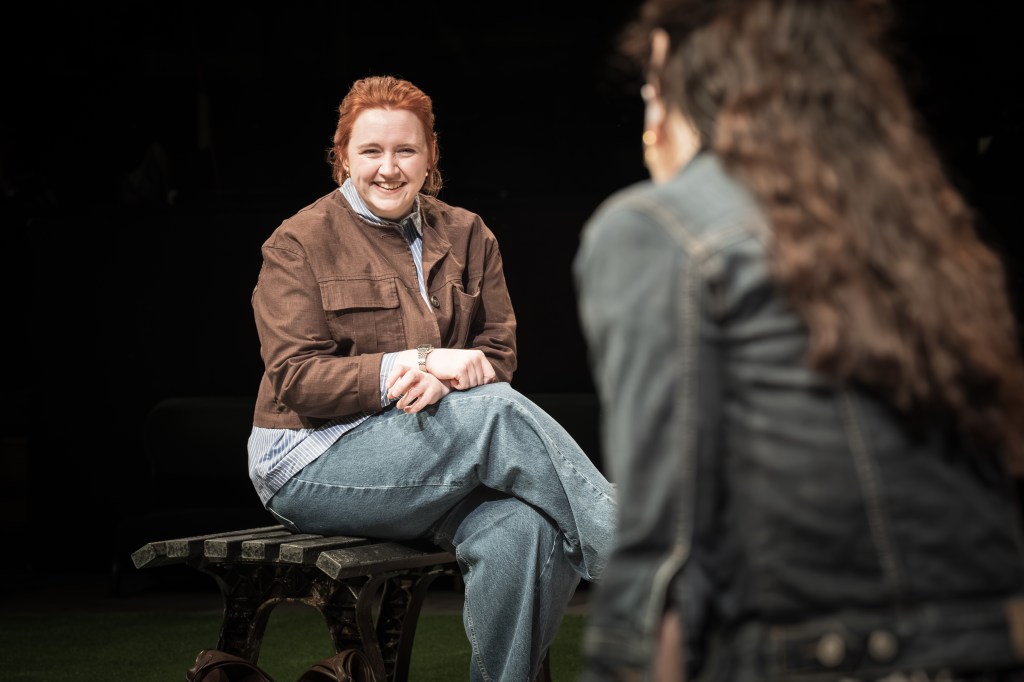
The third act is a meeting between two women in a Manchester park: one, an Irish mother who migrated to Manchester a decade ago (2016 – all the years end in 6); the other, a Manc woman, with an Irish father, who lost a child. It covers a lot of topics, from gentrification and motherhood to various bombings in Manchester and what it is like being Irish in Manchester. Pearce gives a very powerful performance, beginning with a quiet quirky confidence before allowing us to see the grief beneath this facade. Pearce’s character expresses bitterness over a pregnant woman being thrown in the air by the blast of the bomb but her baby being born fine, whilst she lost her baby. The ending, in which Cassidy reveals the date and time (literally right now), is poignant and encouraging.
For a play made up of three distinct plays, each with their own style, it mostly feels fluent, thanks to the slick direction. The intimate, in-the-round theatre heightened the feeling of community, especially with members of the community pouring in from numerous doors, all around the auditorium. When I first walked in to see an empty stage (not even a stage!), I was disappointed, but there is plenty of set that rolls in. Furthermore, the lack of spectacle allows the people, and their movements, to take centre stage. This is a story about Manchester, but Manchester the community, and its people, not Manchester the metropolis.
There are some brilliant ideas, and not all reach their full potential, partially because of the inevitable pacing and tonal issues that arise when doing three very different plays in one – but it succeeds in being a beautiful celebration of community and history.
Even These Things runs at Royal Exchange Theatre until June 15 – the anniversary of the bombing.


One response to “Review: Even These Things”
[…] 20th anniversary. Cartmell also marked the 30th anniversary of that bombing with the brand-new play Even These Things, which closed 30 years to the date of the […]