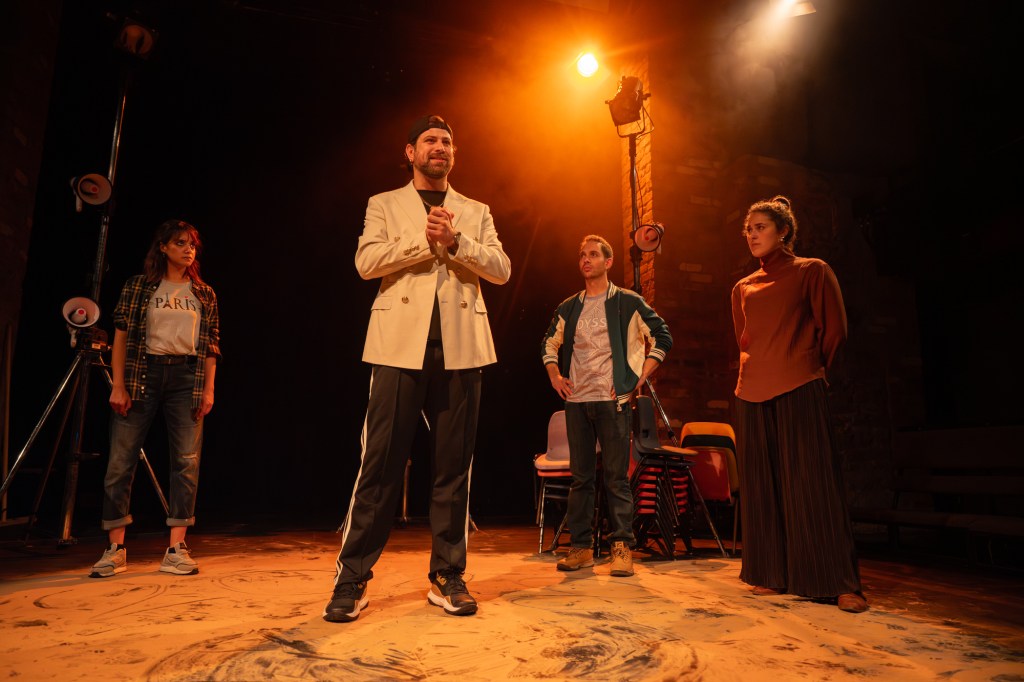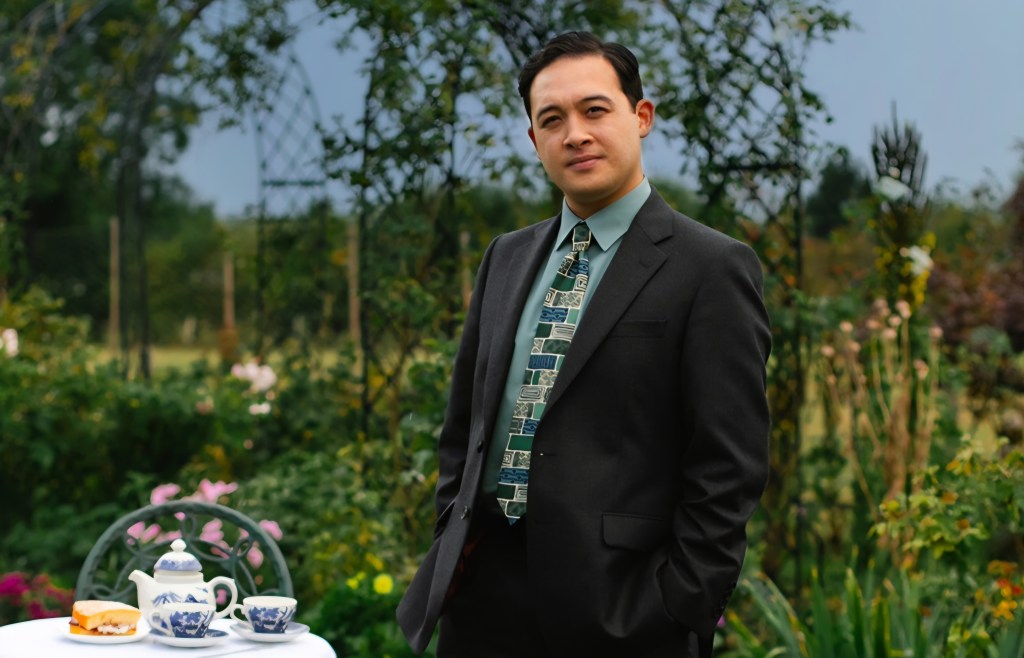
Ahead of Midsomer Murders arriving into Manchester tonight, we sat down with star James Bradwell, who plays Sergeant Troy (Daniel Casey, who played Sergeant Troy in the TV series, is playing Inspector Barnaby in the play).
How’s the tour going so far?
“Good. It feels quite nice. We’ve got the final few to go… four venues after Darlington, where I’m currently calling from. We’ve got Manchester, Dublin, Bath, and then Plymouth, which is mad since we’ve been touring since October.
“But what I love is that the audiences have been so different, and it gives us a new boost. Each week is a new challenge, and the sense of humour changes across the country. It doesn’t quite deliver the same every single time.”
Do you think there’s a big difference between North and South audiences?
“I think so. Just different jokes seem to hit in different ways and different styles of humour just seem to land more. Tuesdays can usually be quite quiet, but we just had our first night in Darlington, and they were so on it with so many of the jokes. It was a very lovely thing.”
It’s quite a comedic show too. How do you get that balance between comedy and seriousness?
“I think what’s lovely about the show is that it does feel like a bit of a love letter to the TV show. And in that way, it’s got a wryness. And I think it’s just very theatrical in a way that the audience finds quite unexpectedly satisfying. And so, it creates this lightness. The tone is light and it’s comedic, and I think that’s what kind of sets it apart from some of the other touring detective dramas… the fact that we are a bit more of a romp, I guess.”
Could you tell me a bit about the show and your character?
“So, I am playing Detective Sergeant Gavin Troy, who was originated by Daniel Casey when the show aired in 1997, and I’m now playing opposite him as Barnaby. Troy in our story is very familiar for viewers of the show. He’s always a few steps behind Barnaby. He does his best, and he’s good at his job, but it’s a long way to go to sort of step up to Detective Barnaby. But, I think, in many ways, the eyes and ears for the audience. He’s trying to follow along just as much the audience is, the entire show.”
How is it working with Daniel Casey? Is it a lot of pressure stepping into his shoes?
“I felt that pressure when I was cast, and I was able to reach out to Dan. Dan has been so generous, and so lovely with his time for me, and being really intent on having our own dynamic that feels like our own detective buddy feeling, in the same way that he had such a longstanding rapport with John Nettles. But he was very clear from day one. He said he’s in the same boat since he’s stepping into John Nettles’ shoes, and those are big shoes to fill. And so that pressure was eased because we were both sort of went through that experience together. And that’s been a really gorgeous part of doing this whole tour with him.”
Yeah, it can be so tricky with well-loved characters, trying to bring your own portrayal with something fresh but also homage someone else’s portrayal.
“Absolutely, I hope that Troy’s qualities are recognisable, but I am doing my own take. I was never going to be doing an impression of him from the show, because I’m opposite the man himself. It would be almost an absurdity to try. So, hopefully there’s a nice freshness that the audience can experience whether they know the show or not.”
And do you feel like it’s quite accessible for newcomers as well as old fans?
“I absolutely think so. The proof’s been in the pudding, because multiple people have come along, who’ve never seen the show, or don’t know the first thing about it, and yet had a really lovely night at the theatre. We had a great conversation with two guys who came to Guildford back in January, and one of them was a massive fan of the show, and he brought a mate who’s never, ever seen a single episode, hadn’t even heard of it. And both of them really loved it in different ways. I just thought that’s a really gorgeous thing.”
So, as well as that, you’ve played lots of different roles across television, gaming, theatre. Is it tricky switching between performance and acting styles?
“I think that’s what I love about it. I think the challenge is that it’s a very different skill set that I’m bringing to each one, and I think with that variety, that’s what keeps me feeling sharp. Incidentally, on Monday, I was doing a video game session, and for the first time I was wearing a headset which tracks your facial movements. And that had its own challenges where I’ve done plenty of motion capture where you have to embody the character from the top of your head to the soles of your feet. And for this time, if I moved around too much physically, the camera would shake, so I had to oddly keep everything completely just in the face and not think about my body too much. That was a really lovely challenge and a stretch. I think that how different it is from theatre informs how I do theatre, or how much I need to really play out for a big theatre compared to when you’re on the TV set on Bridgerton, bringing everything a bit more close in even though they both had a sort of comedic tone. It’s a really lovely sharpening process.”
Is there anything else you’d like to branch out into or experiment with?
“I’ve still yet to do a feature film. I’ve been on TV sets, but I’ve not done a film, which I think is such a different beast. I’ve got friends who’ve done those experiences, and when you’re on the much longest stretch of it and having much more of an arc to play, that’s something that really fascinates me and I think would be a really wonderful challenge to try and get into. But I’ve been very, very lucky with the spread I’ve had across my career. At this point, I feel ready and willing to try my hand at anything. Nothing feels too far off or scary at this point, which is nice.”
I’m a massive gamer, so finding out that you’d done roles in games was very impressive to me!
“And that’s why I put it on my bio, because I was a gamer growing up. I try and do it now but I’ve got less time. My eldest is so happy that I’m doing it. To have my name in a Nintendo game just feels really cool, and I like doing things that are attached to Sony. To be able to do something like Balder’s Gate, where I’m not even the main character, but I did 29 little MPCs all across that world. It’s just a really thrilling thing for me. And I think when those projects come out, I’m just so thrilled to be able to shout about them.”
So, theatre is quite an expressive type of acting. Would you say it’s very different from gaming and television in that way?
“My immediate answer is that I think gaming sits somewhere in between theatre and television. Knowing that you’re kind of being recorded in the same way that you are in TV for a video game, and oddly when its just mostly your voice, you have to be kind of hyper-expressive, and I think about that with theatre, where there can be a problem in certain sort of modern ideas of acting.
“I mean, I’m only 30. I don’t know what I’m talking about as if I’m sort of an old haggard actor director! But too many small choices or choices that feel real but never reach a wall at the very back of an auditorium of 1500 seats, is a problem. And you’ve got to be able to make the choice that feels real and truthful in all of the kind of acting terminology we use, and yet needs to feel like it will hit everyone in the audience and have some effect on everyone. Everyone has paid us to pay for a seat and deserves that experience.
“I’ve been to plays where there’s not much of a physical choice, and I’m not saying you need to gesticulate, but if you’re just still, that may be great for the first five rows, but people up in the gods are going: ‘I just may as listen to a radio play because I didn’t see a choice’. Whereas, in camera, you can trust that what you’re thinking about will go down the lens if you are connected to that motion, feeling or context of the character you’re in. And I love that release that you can have where you don’t need to work quite so hard physically. Eventually, it becomes an instinct. Something else takes over that I don’t need to like think too much about anymore. That’s what I love about getting more experienced… you can just trust the body to do what it needs to do.”
Of course, with movies and television, it’s a lot more zoomed in and cinematic, so I suppose there’s a lot less physicality that goes into it
“Yeah, absolutely. Like if you think about that cinema screen, your eye will be like 20 inches across on that screen. And so you don’t need to do much at all or force anything for it to register with an audience.”
So, bringing it back to the show, why do you think audiences should see it and what makes it unique?
“I think audiences should see Midsomer because it’s just a great night out at the theatre. It’s a really wonderfully entertaining peace. I think right now, in a world where we’re so prone to doom-scrolling, something that can help you just escape and have just a nice time of it is actually more precious than ever these days. You get to see a wonderful ensemble of actors. You get to see a really great, thrilling story. And as I say, I think it sits differently to alongside some of the other theatrical offerings of the detective dramas because it is light and it’s wry and it’s not taking itself very seriously. There’s a lightness of touch. And I think it’s theatre at its best, like this. I think I would be a fool to not recommend that to anyone.”
It would be a crime! So, we’ve touched on what makes the show unique, but why do you enjoy the show?
“I think this is a really lovely project for me because Troy on paper doesn’t have too much to do, especially in the first act, but I’m always on stage. So, I have to be in constant thought, and how I’m processing the mystery as we go along is a wonderful challenge when you don’t have much to say about it all the time. I might have one line and a scene but I’ve spent the entire time on my notepad and listening to each person. And so it goes very quickly for me because I’m always busy, even if I’m not saying anything. Lines are only one part of an actor’s job. And I think that’s what I really, really love.
“And because it changes region to region, and because the energy changes day to day, I just find that such a joy. As an actor, you have to accept what’s going on at the time and where it needs to be for this audience. So, it’s a really lovely exercise every single time. We’ve done it over 150 times now, and I’m still finding something different or a new challenge or wonder how I can tweak that line or what do I need to do next time to make that line sing a bit more in this venue. So, it’s a wonderful constant challenge.”
So, you have to learn off the audience?
“Yeah, because that’s what will always change. The words will not change but the audience energy is different every single time, and that’s the thrill. That’s why I love life storytelling. And in a world of AI and computerisation, despite how doubtful a career it can be, live storytelling is one of the most AI- and future-proof forms of entertainment. As long as fire has existed, we’ve sat around them and told stories. I just think that’s a wonderful thing to be a part of, whether as an audience member or as one of the performers or one of the backstage professionals who go unsung.”
I mean, it is kind of terrifying the way that AI has, you know, impacted the creative industry.
“I think that we will witness how different the philosophy about it will be in this industry where some people are accepting that it’s here to stay, some are saying, ‘maybe there is a way we can use it as a tool within reason’. I think the academy in the US has made a rule that a film can’t be nominated if it’s had anything to do with AI now, so there’s a real good line in the sand. Whereas, a small filmmaker might justify it to achieve that special effect if they don’t have a multimillion-dollar budget. But what’s the purity of art if we are allowing that in? We’re in a very interesting time, very worrying time to an extent, but it will be fascinating to see how AI roots itself or not in different parts, the creative industries in general. I know that theatre posters already are covered in them.”
It’s a worry for voice actors too, with AI potentially taking actors’ roles.
“I feel like before laws come into place, I do worry that some of my work has probably been fed in. I’ve been in Space Marine 2, and you could just feed those lines into a machine without anyone really knowing. There’s no way to track it, and when that data is in, you can’t extricate it. My vocal likeness might be in there somewhere. At the moment, it feels at the Wild West,; there’s not really any control over that.
Would like to add anything about the show, um, or about anything in general.
“I do want to take a moment to really celebrate a massive part of the show, which is our costume and our hair and makeup department. I’m very lucky that I don’t really need to do too much but everyone else in our ensemble is doing a lot of doubling up and playing multiple characters, and that’s a wonderful thing you get to see and bask in how wonderful and how varied their performances are across different people.
“And there’s a whole army backstage where if the set was transparent, you would see the hive of activity. These are people that don’t like to bow. We wanted them on at the curtain called bowing with us. But I do want to kind of shout them out because I think this show is so slick because of their professionalism. It’s just a real thing of beauty. What they achieve in someone walking off-stage and walking back on-stage in seconds flat. I think it’s a real achievement of the show and I hope that’s a thrill for people when they realise how few people are bowing at the end and how smooth and slick it is.”
You can catch James Bradwell in Midsomer Murders: The Killing at Badger’s Drift at Opera House Manchester from May 27 to 30 and on tour around the UK until June 13.