★★★★☆
Walking into Manchester’s intimate 53Two, audiences were met with a musical satire that boldly claims the operatic mantle while tearing up every conventional rulebook. Written and composed by Erik Ransom and produced by Peter Bull, with direction and choreography by William Spencer, Grindr: The Opera – The Unauthorised Parody is an audacious, razor-sharp exploration of modern digital romance and the commodification of human longing.
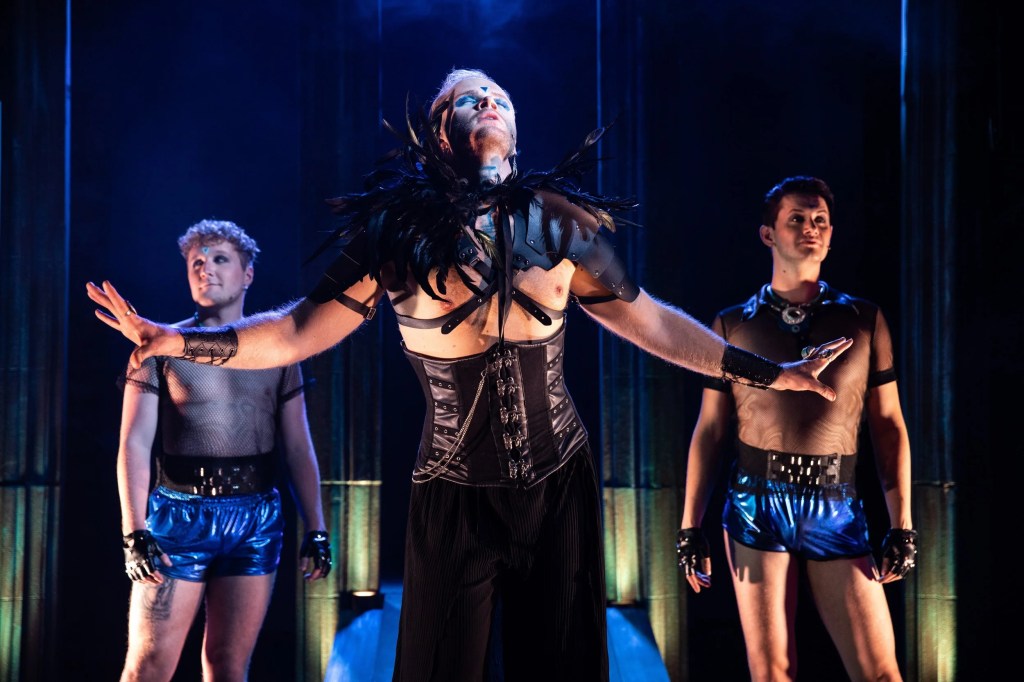
Ransom has noted that he wanted to explore and exaggerate themes commonplace across queer culture in the Information Age, evoking a world of “bare torsos and leather harnesses” instead of “tuxedos and elegant gowns”.
While his promotional materials and libretto nod to classical heavyweights like Verdi and Wagner, the show is technically not an opera in the traditional sense. Beyond the obvious shift in scale, the production lacks true classical operatic architecture: it relies on contemporary musical theatre and pop idioms, verse-chorus song structures, and amplified belt singing rather than through-composed classical recitative, complex harmonic counterpoint, and unamplified classical vocal production like bel canto. Instead, it functions as a cheeky chamber musical or satirical pastiche, backed by a lean chamber orchestra comprising a cello, an electric keyboard, a clarinet, drums, and a guitar. While its musical vocabulary falls short of traditional operatic grandeur, it is more than enough: the score delivers relentlessly catchy numbers and high-octane performances that add up to a thoroughly entertaining, rhythmically driving evening.
Visually, the production is elevated by David Shields’ brilliant set design. A striking, cult-like shrine is erected (pun intended) at the centre for Grindr, flanked by moveable beds, tables, and chairs that fluidly shift the suggested scenes in seconds. Most cleverly, the stage features large frames that the actors inhabit, representing the digital profile grids we endlessly swipe through as though peering directly at phone screens.
The narrative unfolds through an intricate web of modern archetypes whose intersecting lives and secret rendezvous possess the frantic, farcical energy of The Marriage of Figaro. We meet Devon, a romantic doctor searching for genuine love; Jack, a carefree twink looking strictly for fun; Tom, a staunchly NSA-only regular; and Don, a closeted, married daddy wrestling with the friction between suburban respectability and digital desire. Overseeing this chaotic mating dance is the app itself—not just personified, but fully embodied as Cupid’s cynical antihero—brilliantly brought to life by Christian Lunn.
Lunn’s breathtaking falsetto work and vocal dexterity add an otherworldly, manipulative allure to the character. What makes his performance truly arresting, however, is his relentless commitment: even when lurking silently in the shadows in the background, his predatory movements, prowling posture, and villainous facial expressions never drop, brilliantly anchoring the app’s omnipresent psychological gaze in physical theatre gold.
The rest of the cast matches this ferocious energy, with Kane Verrall (as Tom) sharing vocal powerhouse duties alongside Lunn, while Will Joel and Patrick Barrett round out a uniformly brilliant ensemble.
The audience, unsurprisingly, skewed 100% male and predominantly queer. This created a wonderfully electric, shared atmosphere where the jokes landed effortlessly. The room collectively recognised and winced at the underlying truths: the crushing weight of modern alienation, the addictive architecture of notification pings, a system that systematically breaks romantic hope, and the ultimate, dark comedy of surrendering our self-worth to the modern gay deity brought to life in the show’s striking opening scene, Grindr himself. Summoned through a sacrificial, cult-like ritual chanted in Latin—”Sed domi maneas paresque nobis novem continuas fututiones. Pedicabo ego vos et irrumabo, et irrumabo” (translate it with discretion)—this digital entity looms large over the unfolding chaos.
The production handles its intensely mature and sensitive themes (such as STIs and the potential dangers of meeting up with complete strangers) with both audacity and care. The lyrics are unapologetically, breathtakingly explicit, featuring graphic, overtly sexualised language that leans fully into its subject matter. As they should be. The choreography matches this delicate balancing act, translating the physical and emotional vulnerabilities of the characters into sharp, evocative, and highly erotic movement on the compact stage. Crucially, the production is supported by intimacy director Emma Bailey, ensuring that the physical staging on the compact stage remains both safe, convincing, and sharply choreographed.
Yet, like any ambitious fringe venture, it has its rough edges. There are a few missed opportunities; a moment nodding to a premium tier like Grindr Xtra begs for a distinct visual shift, perhaps a flash of gold costume change to highlight the satirical class divide of modern app monetisation. Furthermore, technical gremlins hampered the experience slightly: whether due to the acoustic challenges of 53Two’s industrial, intimate venue or the balance of the microphones and speakers, the lyrics were occasionally unintelligible, losing some of Ransom’s sharpest, most cynical punchlines in the mix.
These minor sonic hiccups aside, this is vital, fearless fringe theatre that turns the existential dread of modern scrolling into high camp, reminding us why we must fiercely protect queer art: it offers a space to laugh at our own shared neuroses, holding up a cracked, neon-lit mirror to the ways we seek connection in a disconnected world.
Grindr: The Opera – The Unauthorised Parody runs at 53Two until August 29 and tours the UK until September 12.
Photo: Brittain Photography