★★★★☆
A decade after its release, acclaimed Persian-language horror film Under the Shadow has been adapted for the stage. Under the Shadow follows a mother and daughter in Tehran during the 1980s Iran-Iraq war. If the real-life horrors of war are not enough, things take a turn for the worse when a djinn (a supernatural being in Arabian and Islamic mythology) starts haunting them. A philosophical exploration of psychology, mythology, politics, war, grief and trauma, its premiere could not be more timely, as bombs once again fall down on Iran, and the Islamic Republic cements its control over its unwilling population.
Whilst I have reviewed plenty of shows and events in London, on an ad hoc basis, it has been over three years since I last went down specifically for a press night, but, as one of very few Muslim reviewers, and perhaps the only reviewer with Iranic roots (Afghan – Pashtun and Tajik), it was an absolute honour to attend the premiere of a play based on a ground-breaking Middle-Eastern film, which has a story rooted in Islamic mythology.
The play follows the film very closely with some changes as almost all of the action is now located in one apartment, with basement scenes taking place beneath the stage, with actors popping up from below as the lights are switched off onstage. This is just one example of director Nadia Latif eloquently translating this iconic film to the stage.
The attention to detail in the script, written by Carmen Nasr – based closely on the film script by Babak Anvari (who also directed the film) – is exquisite. This is not just a horror (both supernatural and psychological) but also a domestic drama and something of a political thriller. All of these genres are interlinked, with the real-life horrors of oppression and war informing the characters’ psychological torment and trauma, which possibly manifest into supernatural visions, themselves informed by religious teachings, perhaps as a coping mechanism (supernatural horrors even worse than the horrors of real life).
Ostensibly, the characters are actually being haunted by a djinn, who seemingly arrives with an Iraqi missile and possesses and haunts broken, tormented individuals. The djinn is perhaps metaphoric for the Islamic Republic itself, in which hard-right Islamists filled a power vacuum after people from all across the political spectrum united to topple the brutal Shah (who had been installed by the West, after they overthrew the democratically elected Prime Minister). That the djinn arrives with a missile is commentary on the wickedness or war.
The djinn, when finally seen, is cloaked in black. In one scene, the djinn disappears, and in its place is a woman in a black hijab. Later, the djinn takes on the form of a woman in a hijab. This locates the Islamic Republic, with its misogynistic forced veiling, as the central horror. This interpretation is supported with the knowledge that Anvari based this story on his own experiences in Tehran during the war, and his fear of djinns, but reimagined the story from a female perspective, with a mother and young daughter, so he could speak to the issue of women’s rights in Iran.
The protagonist, Shideh (played by Leila Farzad, who brings both poise and desperation to the tole), had been training to be a doctor, like her husband, Iraj (a charming Nicholas Karimi), but is unable to return to her training because of her leftist activism preceding and during the revolution. In Iran (unlike Afghanistan), women are allowed to be educated (Iranian women are, in fact, more educated than Iranian men and many Westerners) and work but Shideh is prevented because of her personal politics, which she rescinds, whilst veiled, but this is not enough. She is relegated to being a wife and mother, which she admits, to her daughter, is not enough for her. She is her own human being but she has been denied her humanity. This monologue is soul-crushing, and Farzad’s delivery is devastating.
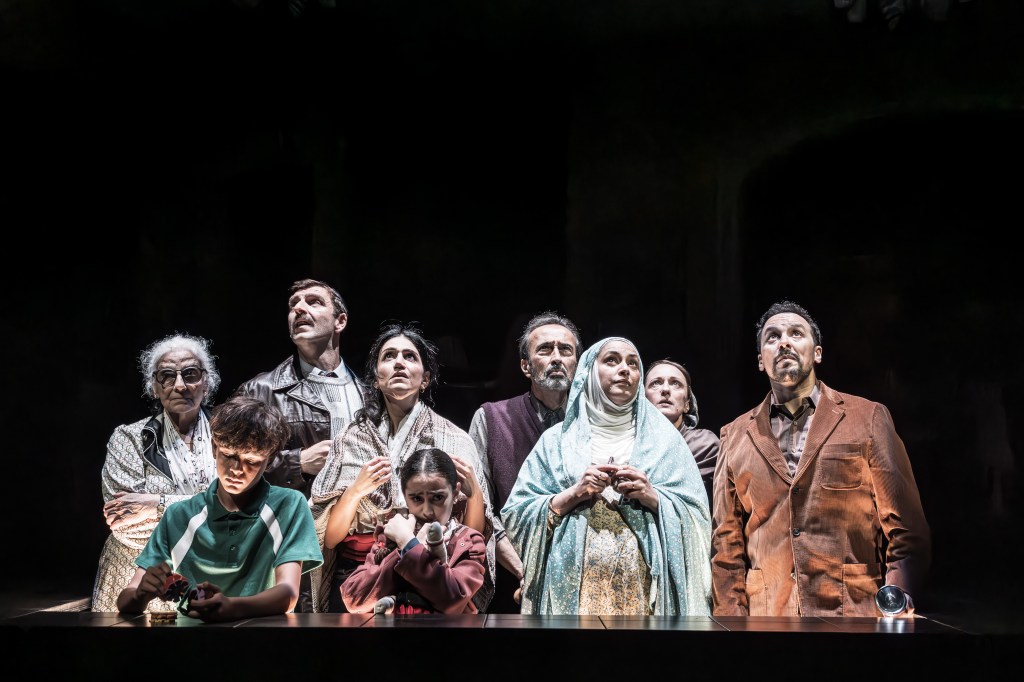
Anvari and Nasr speak to varying issues, ideologies and viewpoints with the supporting cast, with the characters all reacting noticeably differently to their experiences with war and djinns. Whilst Shideh and Iraj appear irreligious, Shiddeh eventually accepts the existence of djinns, but whilst other characters pray, which displays the role (and positivity) of faith in difficult times, she never goes that far. Mrs Fakur (Souad Faress) is a progressive older lady who seems to dislike religion and refuses the idea that a djinn is haunting the building whilst Mrs Ebrahimi (Mona Goodwin) is much more religious and conformist, repeatedly criticising Saddam Hussein, whilst Mrs Fakur reminds her that there are two sides to every war. Her husband, Mr Ebrahimi, is played by Rachid Sabitri, who also plays the Doctor. Nadia Ablina plays Pargol, a woman caring for her elderly father, Mr Birjari (Bijan Damneshmand), with the pair also portraying he Secretary and the Director, respectively. On press night, Shideh’s daughter, Dorsa, was played by Erin Jemmotte, whilst Rohan Berry played Mehdi, the Ebrahimi’s newly adopted son, who tells Dorsa about the djinn, which informs the haunting.
The most interesting political debates take place in the basement, where the inhabitants are hidden away from not only bombs and djinns but also the oppressive regime; here, they can speak freely. There is excellent attention to detail throughout the play, with Shideh working out to illegal Jane Fonda workouts not only to give the bored housewife something to do but also as a small act of rebellion and resistance. Indoors, she shows her arms, covering herself with a scarf every time she answers the door signifying a willingness to conform for her own safety, and that of her daughter’s – unlike Mrs Fakur, who walks around the apartment building unveiled.
Attention to detail is also seen in Ben Stone’s set, which is so very 1980s Iranian that it is hard to believe that a White man designed it; he clearly did his research. Khadija Raza’s costumes are also very period appropriate and have things to say about their characters, such as Shideh’s aforementioned “revealing” clothing. Lighting is always important in a stage horror; James Farncombe excellently captures intimacy and domesticity shattered by war and hauntings. At one point, the ceiling is literally shattered by a missile, with light creeping through, perhaps representing a desire to escape.
Whilst the film is performed in Persian/Farsi, the stage play is not only performed in English but also with various British accents, which feels a bit out of place but might be an attempt to make it feel more relatable to British people, not allowing us to be voyeurs but forcing us into the action, reminding us that nationality is simply a matter of luck. Whilst the story is so specifically Iranian and Islamic, this might be an attempt to make its themes more universal, but I’m not sure how well it pays off.
After the show, I spoke with Arty Froushan, a British-Iranian actor who portrayed Patrick Bateman in American Psycho (my favourite show of 2026!) at the Almeida Theatre earlier this year. We both expressed disappointment in the play doing away with the melodious nature and lyricism of Persian/Farsi and Arabic. Whilst one character reads an Islamic prayer in Arabic, there is a noticeable lack of well-known Arabic and Islamic words, phrases and expressions, which even Muslims who speak only English, like myself, know and use. At one point, a character sarcastically says “God-willing.” “Say ‘Inshallah’!” Arty and I said to each other. If Joe Biden can sarcastically say “Inshallah” in a presidential debate, a Muslim character can say it in a play!
The first act is a real slow-burn with teases and sprinklings of horror. Sometimes you forget it’s a supernatural play as it feels so much like a politically informed domestic drama, with the acting rooted in naturalism and realism. This is an interesting narrative device as it makes the horror feel more, well, horrifying, when it eventually arrives (the end of act 1 is terrifying). Nasr succeeds in gradually building tension before things go wild.
The film does not always translate so well to the stage, with the first act occasionally feeling a little languid. In films, things can be achieved with angles and glances, whilst on stage, these moments can become exposition heavy. The significantly shorter second act sees the play transform quite radically, which some might find jarring, but it could represent the Iranian revolution, which felt sudden, and perhaps at first positive and hopeful, only for it to quickly transform into something quite terrifying – and even worse than the brutality before.
The ending is bittersweet, with the characters fleeing for their own safety, after defeating the djinn, but we know that they are unable to defeat the real-life monsters. We know this because we are living in the aftermath of the Islamic Republic massacring thousands of its own people who dared to defy its orders. One can take two different things away from the ending. Shideh confronts the djinn but she mostly defeats it by rallying with her daughter, which represents people, but especially women, uniting to fight back. But, in the end, they flee, which seems to be an encouragement for people to put their safety, wellbeing, and lives first, just like Anvari did when he left Iran. There is so much that one can take away from this ground-breaking, thought-provoking, gut-punching, heart-wrenching play.
Whilst I left the play feeling joy and delight over seeing an iconic Middle-Eastern film brought to life onstage – and my part of the world represented onstage, with sympathetic characters who are not terrorists, tyrants or mere victims – I am ending this review with tears in my eyes, as I reflect on the ongoing horrors which my ancestors left behind. No djinn is a match for the monstrosity of man. Hell is empty, and all the devils are here.
Under the Shadow runs at Almeida Theatre until July 4.
Photo: Marc Brenner

