Four years after its premiere, the Olivier Award-winning queer Pakistani play The P Word has been remounted at the Bush Theatre. As racism, Islamophobia and anti-immigrant and anti-LGBTQ sentiments sweep the nation, its remount could not be more timely and relevant.
A two-hander, or a duologue, The P Word follows two gay Pakistani men: one, a British Pakistani suffering from self-hatred; the other, an asylum seeker who flees homophobic persecution in Pakistan.
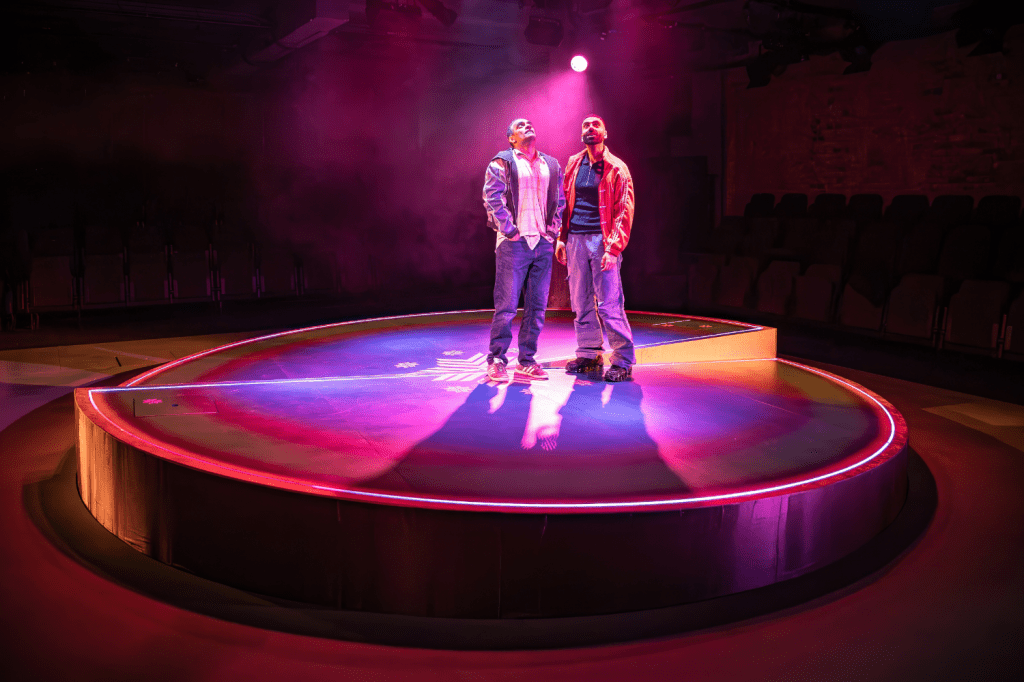
Max Johns’ slick, revolving set (associate set design by Maariyah Sharjil) consists of two half circles which slope the opposite way, like a fresh take on yin and yang, seemingly representing the similar but different experiences of the two characters, who are paralleled, and their will-they-won’t-they relationship. Whilst the audience sit in the round, which could feel voyeuristic, this is quashed quickly as the actors immediately, and repeatedly, speak directly to the audience, immersing us into not only the action but also the narrative, forcing us to reckon with our own complicity. I was quite amused, and honoured, when writer and performer Waleed Akhtar looked and pointed directly at me when he referred to hooking up with someone!
Director Anthony Simpkin-Pike makes excellent use of the space (movement direction by Rachael Nanyonjo), with the performers constantly moving around not only the circular dais platform but also the floor space. Whilst there is not much set, just a few props and costume changes (also Johns, with Sharjil), the creative team fluently transport the audience from place to place through artistic lighting (Elliot Griggs), sound design (Xana), and original compositions (Niraj Chag), as well as famous songs. Furthermore, the script is so rich and thorough that even an unimaginative person in the audience will see a world built around them, and the performers are so captivating that, even if there was a flashy production, all eyes would be on them.
The script, by Waleed Akhtar, who stars alongside Esh Aladi, addresses countless themes and topics, some of which are sub and micro. It’s occasionally a little unfocused; there are a few points which are teased and tantalised but ultimately brushed past because there is not the time to do them justice so a brief mention will have to suffice because it is ultimately better than only half exploring a topic.
The play begins with the two characters telling the audience about their personal experiences. Billy’s (whose real name is Bilal) experiences are ostensibly shallow, especially when paired next to Zafar’s literal fight for his life, but there is so much going on underneath Billy’s bravado, most noticeably, internalised racism, which is, of course, informed by external racism. Zafar flees homophobia in Pakistan only to experience racism and xenophobia in the UK (this could have been rewritten in the contemporary context of rioters literally setting fire to asylum seeker accommodation). Billy experiences both homophobia and racism, including racism from the queer community and homophobia from the Pakistani community. Akhtar eloquently, intellectually and intersectionally explores the difficulty of being doubly (or triply) marginalised.
Racism in the queer community is something I wanted to explore in more detail in the 3x Royal Television Society Award-winning documentary Bend It Like Bollywood, which I created and associate produced for ClockWork Productions and BBC Three, but, alas, there is only so much you can do in a 45-minute film – so I was so glad to see it explored so thoroughly in The P Word.
Something else I’d hoped to explore was the long, rich queer history of the Indian subcontinent, particularly with the hijra, which British colonialists illegalised. The P Word touches on this, with Zafar acknowledging what the Brits did whilst the British-born Billy says that we cannot blame the Brits for everything, particularly when India has gotten over homophobia. There is also a brief mention of Islamophobia in India, with Zafar joking that modern Bollywood films are great if you can get past all the Islamophobia. Whilst it would be interesting to explore this in more detail, it could feel forced, and there simply isn’t time, and that is not what this play is about; no play can do everything – or certainly not do everything justice.
The script gains energy, intensity and momentum when the characters meet. Their meeting is very powerful and exciting; we can see and feel it coming, like two worlds colliding. Billy’s transformation arguably comes too quickly but the shortness and speed of this production are ultimately an asset. It’s such a whirlwind.
The play knowingly drives towards a happy Bollywood ending, drawing the audience deep into it, before completely ripping both the characters and the audience out of it. Whilst it’s powerful and deliberately jarring, it is arguably over-emphatic and a little on the nose; the story, itself, has already edified and enlightened its audience. But I appreciate that the meta ending makes it more grounded and real – and it also has something to say about the fantastical escapism of Bollywood and perhaps also the keeping-up-appearances mentality of South Asians. This production is self-aware, never self-indulgent.
Whilst The P Word is heavily rooted in real-world activism, contemporary UK political policies, and the collective experiences of queer South Asian men, it is passionate, powerful and poignant, but never preachy – how are those for P words?
The P Word runs at Bush Theatre (Holloway Theatre) until June 27.
Photo: Craig Fuller
 JADAR
JADAR 