The Last Man is a one-person zombie rock musical which has come to London following a sold-out run in Seoul. It is now playing at Southwark Playhouse Elephant, with its original director Daljung Kim teaming up with dramaturg Jethro Compton to bring the show to British audiences. It’s full of meta references to zombie and survivor movies and, on paper, it’s my new favourite show. It clearly has a lot of heart (or “jeong”), but unfortunately, it leaves
audiences wanting.
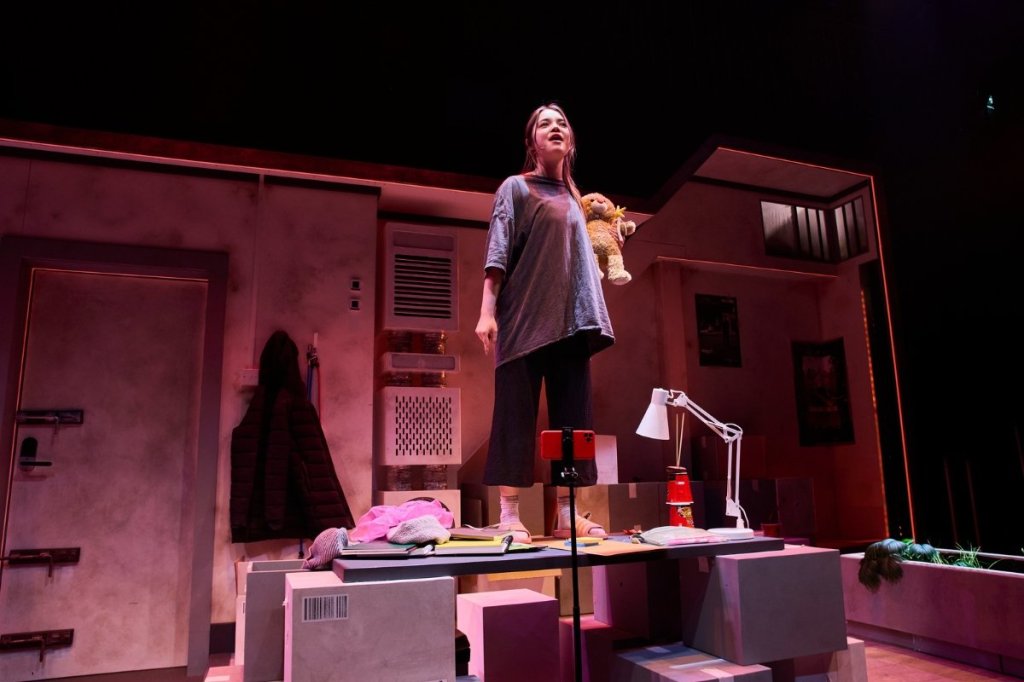
Before you take your seats, the theatre has playful directions to the “bunker”, or the auditorium, and you enter to see the stage as an underground flat. The set design by Shankho Chaudhuri is maybe my favourite thing about the show. The survivor, played last night by Korean-Kiwi actor Lex Lee, tells us about these mostly underground flats called “banjiha” in which many people in the Korean capital live. You might recognise the concept from Bong Joon Ho’s Parasite, but here the set playfully toes the line between modern, underground living and the discomfort of an underground hideaway. Made of reinforced concrete and industrial steel, the survivor has chosen this as his ideal hideaway to survive the zombie apocalypse.
The music was enjoyable and charming, and played very well by a live band who sat on a balcony just above the stage. But while it’s advertised as a rock musical, I feel like the songs were more inspired by traditional musical theatre numbers, to the extent that it feels formulaic and pretty predictable. We’ve got songs about “motherfuckin’ zombies”, and memories before the bunker, but nothing that really breaks the mold. Lex Lee, however, is a very capable vocalist with great control of his voice, even while singing on behalf of his teddy, his sole companion in the bunker. I’m interested to see what he does next.
There’s some odd choices made with screens, wherein the actor vlogs these talking heads and we watch them streamed in real-time on screens above his head. In a very small theatre, it seems unnecessary, and I started to wonder why they wouldn’t use the screens to build some zombie tension. But as members of the audience began to predict, the show gives us a reason for this anticlimax that is at best disappointing and at worst, distasteful.
Unfortunately, a two hour play in a small flat with a protagonist who is even bored of himself, requires something more exciting to hold the audience’s attention. It’s a lot of monologuing, with a lot of named references to popular zombie films, including Zombieland, World War Z, Shaun of the Dead, to name a few. It tries a lot of Zombieland-style quips, but nothing that really gets a laugh, and as half of the punchlines seem to be “motherfucker”, the humour feels fairly adolescent and unfortunately doesn’t land. It’s a show that’s obviously aware of the huge presence of zombie film in popular culture over the years but it hasn’t grasped that audiences don’t need long monologues or songs explaining what a zombie is and does. And as you’re sitting watching the actor talk to himself, you do start to wonder why, despite all this fuss, there doesn’t seem to be any tension.
Spoilers ahead: In the second half of the show, Lee gives a very compelling and often disturbing performance of a man who has lived underground for a year. There is some convincing gagging and retching, and an uncomfortable descent into an almost inhuman state of being. As we watch this transformation, the survivor’s clumsily-built radio finally receives an SOS message, I find myself itching at the possibility that something might actually happen, but alas, it wasn’t to be. Soon, the landlord, unscathed by zombies and angry, is knocking on the door. Ah, so that’s why the show had no scary zombies or real sense of tension: we’re going for the old “it was all a dream” trick. Or, in this case, the hallucinations of a seriously unwell man who has locked himself away from his family for months on end. It should feel disturbing or heart-breaking, but it’s just a confusing choice.
With no sense of why that would be the case or what has compelled him to live this way, it just feels like lazy writing. I was really rooting for The Last Man; it’s a fun concept that had a lot of potential. But it needs something more — tighter direction, or higher stakes, or funnier jokes. What you get is a few enjoyable songs, a lot of awkward vlogging, and no zombies, which is a lot of fluff with no substance for a two hour show. Maybe, with some workshopping, it could become something great. But as it stands, ironically, it’s a little lifeless.
The Last Man runs at Southwark Playhouse Elephant (Main Space) until June 13.