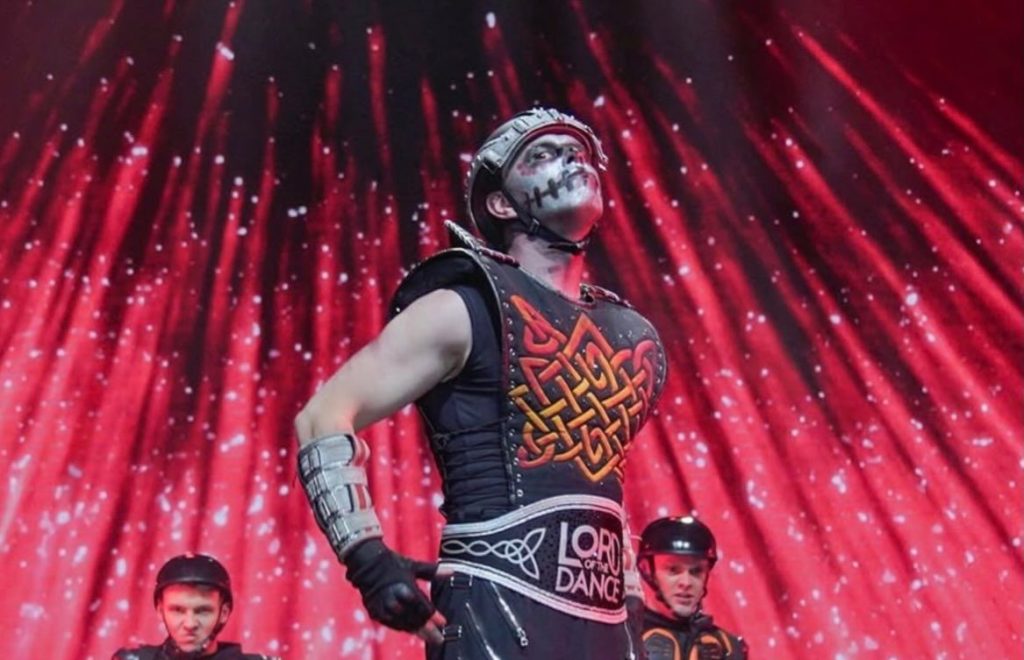
Ahead of Michael Flatley’s Lord of the Dance coming to Manchester, we sat down with Manchester’s own Sean Scally, who plays the Dark Lord.
This is not your first international tour with Lord of the Dance. Do you feel a difference between audiences in different places?
“Definitely — the UK crowds are a lot more reactive than some other countries. They’re definitely a bit rowdy, which is good. Dancers like a bit of reaction and when everyone is taking part. It is interesting to see how audiences in different countries vary from each other. Some are a bit reserved until the end and then explode into appreciation at the end of the show; others show it all the way through. The UK audience seems to be at the same level the whole way through, so you’re not guessing what’s going on. It’s nice to have good audiences, and especially in Manchester — in the troupe it’s a known thing that Manchester is always a really good place to perform, with really good audiences, so everyone’s looking forward to it.”
What does your dancing career look like?
“I started dancing at 4, doing competitions as it is a very competitive scene until you reach adulthood. At 17, I started touring with loads of different shows until eventually I got into Lord of the Dance nearly seven years ago, right before COVID, so I think I was about 22 when I joined. I’m not sure exactly how many countries I have visited with Lord of the Dance, but generally I know I’ve been to 54 countries now — I keep track on my notes. Hopefully we can tick off a few more in the next few years. It’s a great way to travel and see the world, and I’m grateful for the opportunity to do it.
“Most of the countries, you do see a good bit of. It’s hard work with the show — there’s a lot of rehearsing and lining up the shows and practicing — but you do tend to get enough time to go and see places if you want to. I love seeing different cultures and traveling, so I make sure I can find time to see at least some of the country and experience some of the culture, wherever we are. There are some places where we only do one or two shows, so it’s more travel in, do the show, travel out — but on the whole, we do generally get enough time to experience the sights.”
You’ve been with Lord of the Dance for years now — are you still excited about every show, especially this one, given it’s the 30th anniversary and an opening night in Manchester?
“Absolutely. I think every time we go on stage there’s always something slightly different, which gives you that little bit of nerves and excitement. You never just nonchalantly walk on stage. When you see the audience for the first time, it always gives you a bit of goosebumps, which is good. Especially this week, being in my hometown and in a big anniversary show, it’ll be really good to see family and friends who are coming to see the show.
For this show, it’s my mum, my dad, my dance teacher, and a few friends who are coming tonight, and there will be more friends and family coming throughout the week. So, every show in Manchester is going to have a bit of added specialness and a few more nerves. From the audience’s side, you look at us as performers and dancers, but there’s a human layer too — when you know there are people in the crowd who support you personally, it adds a bit of nerves.
“I think this tour is special for everyone as it is an anniversary. Even for people who’ve seen the show before — it’s been revamped and modernised, with new lighting, new costumes, and some new dances. I personally think it’s one of the best versions of the show and everyone’s worked really hard behind the scenes to make it as good as we possibly can.”
Irish dance requires such precise coordination — patterns, lines, formations. Is there a secret to never making a mistake, apart from practice? What happens if someone forgets a step on stage?
“There are obviously going to be moments where things do go wrong, not massively, but there are a few things you can adjust to help it come across seamlessly to the audience. The biggest thing is still practice. Every day before the show, we go through every single number, make sure the lines are correct, nobody’s out of line, and the formations are even. It’s a case of rehearsing every day, rehearsing before the tour starts, and making sure everyone has the right level of fitness. Because if you’re not as fit as the rest of the cast, or a little slower, the eye is going to be drawn to you, and with 30 dancers on stage, you don’t want that. You want everyone doing it in unison as a group.
“Michael handpicks every dancer in the show, so you have to be the crème de la crème to get in in the first place. Once you’re successful in the audition process, it’s on you to maintain those standards the whole way through, to keep your place and keep the high standard of the show. Everyone in the show is representing Michael, and he’s mainly the reason we all started dancing, and the reason professional Irish dancing became a career at all. It’s a pressure, but a good pressure, because everyone has pride in their work and wants to perform as best as they can.
“Before every show, we have to line up the show, so we come into the theatre about five hours beforehand. We have a mixed line-up for numbers involving both male and female dancers, and then a separate male line-up and female line-up, rehearsed every day to make sure the lines and formations are perfect, especially because the leads change each day, so different people are in different spots and everyone needs to know their steps for their position.
“Before a tour starts we also have weeks of rehearsals, and during time off, everyone rehearses and trains on their own to keep up fitness and stay as ready for the tour as possible. You don’t get ready for a tour while you’re on it; you get ready in the weeks and months leading up to it to make sure the first show is as good as the hundredth.”
Have you ever thought about what you’d have done if you hadn’t been introduced to dancing when you were a child? What would your backup plan have been?
“[Laughs] I’d like to think it would have been something like a footballer but I’m definitely nowhere near good enough for that. My mum and dad are both Irish, and I grew up immersed in Irish culture. Even before I was dancing, I was playing Irish traditional music and Gaelic football. So, I think, given time, I would always have ended up trying dancing, if not exactly at four, then at some point later. It felt kind of inevitable, given how immersed I was in Irish culture as a child. It was not a case of ‘if,’ but ‘when.’
“I don’t really know what I would have done otherwise, to be honest. I started so young it could have gone any way. Even when I was competing, I was never a great competition dancer, but I always knew, in my head, that I wanted to join shows. I was watching Lord of the Dance and Michael Flatley on repeat as a child. I always wanted to do professional shows and travel the world, so it’s worked out quite well.”
Michael Flatley’s Lord of the Dance tours the UK until October 17. Check out our review.
Photo: @seanscally141 on Instagram

