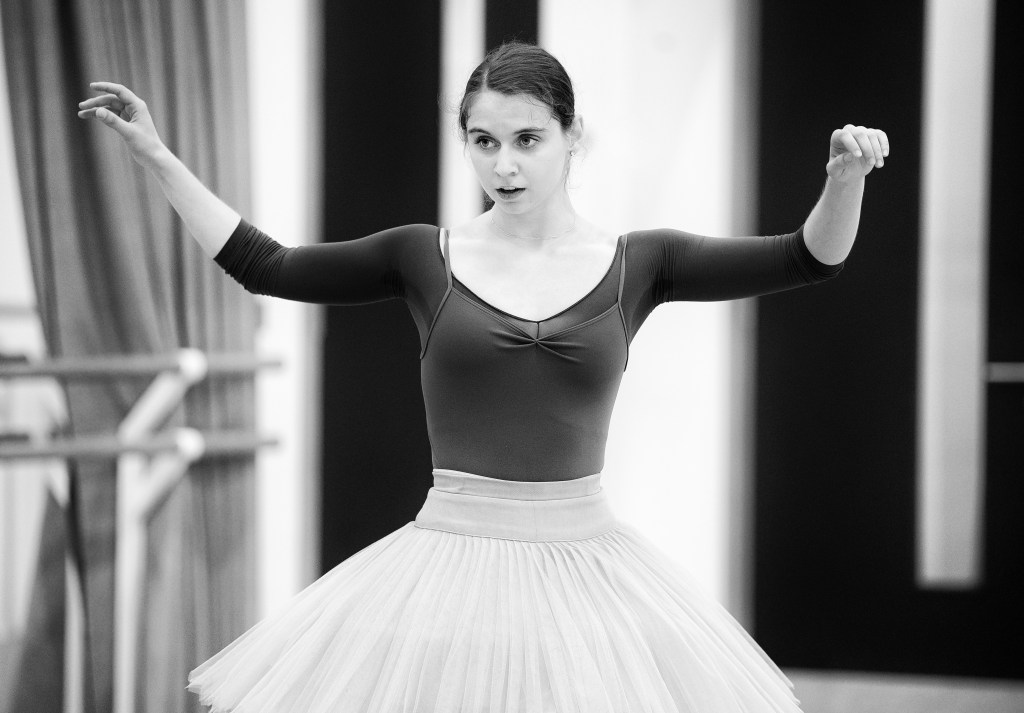
As English National Ballet prepares to bring Rudolf Nureyev’s Romeo and Juliet to Manchester in October 2026, newly appointed Principal dancer Julia Conway reflects on the role she has long dreamed of performing, the freedom of finding her own Juliet, and why ballet still has the power to move audiences.
There is a particular kind of magic in watching a ballet dancer make something extraordinarily difficult look effortless. A leap seems to suspend time; an embrace becomes a story in itself; and a movement that has taken years to perfect appears, for a fleeting moment, as natural as breathing.
For Julia Conway, the newly appointed Principal dancer at English National Ballet, that sense of freedom is at the heart of her artistry. She wants audiences to see not simply the precision of the choreography, but the pleasure of dancing itself.
“I think when I’m on stage, you can see that I like being there. It comes across that I’m enjoying myself, and I get a little bit lost in it.”
It is a fitting introduction to a dancer about to take on one of classical ballet’s most coveted roles. This October, Conway will dance Juliet in Rudolf Nureyev’s Romeo and Juliet, as English National Ballet brings the production to the North of England. For a ballerina, Juliet is more than a celebrated character: she is a test of technique, dramatic imagination and emotional vulnerability. For Conway, the opportunity is also the realisation of a long-held ambition.
“This was one [role] that I was always really looking forward to […]. You ask almost any ballerina what their dream is, and most people would say Juliet.”
A childhood drawn to the stage
Conway’s relationship with ballet began long before she could have imagined herself dancing the great romantic roles. She was born in London, where her mother introduced her to the art form. Having danced as a teenager herself, her mother was delighted to share her love of ballet with her daughters.
Conway’s older sister, however, was less interested in ballet; Julia was the one who was captivated.
Her mother took Julia to performances at the Royal Ballet before the family moved to the United States, where their outings continued at New York City Ballet and other companies. These early encounters offered her an introduction to the many worlds ballet could contain.
“I just loved going with her,” she recalls. “I thought it was so fun. I loved the costumes, the storytelling aspect of it, the beauty and femininity. All of that drew me in.”
Asked whether one particular performance made her want to be on stage herself, Conway hesitates. The memory is not entirely clear but she suspects it may have been Cinderella or The Sleeping Beauty. “It was probably the tutu… very girly, very sparkly,’ she says with a laugh.”
But it was not one single performance that determined her future, but the gradual accumulation of these experiences: the theatrical spectacle, the music, the costumes, and the possibility of inhabiting another world. Ballet began as something she loved watching, then became something she wanted to do. Classes followed, and her interest grew from there.
“I was really lucky because I was introduced to it at a very young age.”
That early sense of wonder has not disappeared with professional experience. If anything, it seems to have become an essential part of the way she approaches her work. For Conway, artistry is not simply about achieving technical perfection. It is also about remaining sufficiently open to the experience to lose herself in it.
Becoming a Principal
Being named a Principal dancer is a milestone many young ballet dancers aspire to but only a few achieve. Conway admits that she was surprised when the promotion came.
“I wasn’t sure it was ever going to happen. It’s what we all strive to become, but very few people get there.”
The title brought excitement and honour but also an unexpected degree of self-examination. Having spent years looking up to Principal dancers, she suddenly found herself occupying the position she had once admired from a distance. The image she had carried of a Principal was almost impossibly elevated: a performer who seemed complete, assured and somehow beyond the ordinary uncertainties of a dancer’s life. Her first instinct was to compare herself with that ideal.
“I kind of looked at myself and thought, ‘Am I what I always saw Principals to be? I grew up thinking they were these perfect characters. And I thought, ‘Oh, my God, I’m not that.’”
There is a recognisable vulnerability in the admission but Conway does not describe it as a negative experience. Instead, it has made her think more carefully about the standards she wants to set for herself, asking “How can I, with integrity, shape myself to be as much like those people who inspired me as possible?”
It is an approach that suggests she sees the promotion not as a final destination but as the beginning of another stage of development. There is no single moment at which a dancer becomes artistically complete. Each new production offers another opportunity to discover something, refine something, or understand a character differently. For Conway, the ambition remains less about collecting prestigious roles than about becoming a better dancer through the experience of performing them.
“I want to improve my dancing and my artistry through every production, through experience.”
The demanding world of Nureyev’s Romeo and Juliet
If Juliet represents a dream role, Nureyev’s choreography ensures that the dream is anything but easy.
English National Ballet’s Romeo and Juliet is returning after nine years, meaning that much of the company has had little or no previous experience of performing it. Preparation has therefore been a long process of learning, revisiting and refining.
Conway and her colleagues first learned the ballet in May 2025, working on it for a month before turning their attention to other productions. They returned to it in August this year for another intensive period, only to set it aside again for a contemporary programme at Sadler’s Wells. With that programme completed, the company had to switch back into the world of Romeo and Juliet ahead of the performances in Liverpool and the subsequent Manchester engagement. “It’s been, like, here and there, on and off. We’ve been working really hard every day.”
The preparation has included guidance from coaches associated with Paris Opera Ballet, which also performs the production. Their expertise has helped the dancers understand not only the choreography but also the particular dramatic language of Nureyev’s interpretation.
Conway sees this version as distinct from the Romeo and Juliet most familiar to many ballet audiences: Kenneth MacMillan’s celebrated staging. Where MacMillan’s ballet is known for its emotional intensity and expansive storytelling, Conway describes Nureyev’s interpretation as grittier, messier, and closer to Shakespeare’s original drama.
But the difference is felt physically, too. Nureyev packs an extraordinary amount of movement into the music, leaving the dancers with little opportunity to recover between sequences.
Where MacMillan has two steps in the music, this one will have eight. There’s just so much more choreography within the same music.
The result is a demanding test of stamina. Conway points to Romeo’s first act, in which one solo seems to lead almost immediately into another, followed by a pas de deux and further sequences. The choreography continues to ask for more even as the dancers’ energy is being depleted.
Nureyev himself was reputed to relish dancing to exhaustion. Decades later, the physical consequences of that approach are still being felt by the performers who take on his work.
Yet the exhaustion is not simply an obstacle to overcome. In the central partnership, physical effort becomes part of the dramatic relationship.
By the end of the balcony pas de deux, Conway explains, the dancers are genuinely relying on one another. Their movements become an exchange of strength and support rather than a conventional display in which the male dancer does all the lifting.
It becomes like a very 50-50 partnership. She’s pulling him at moments, really like, “Okay, let’s do this together to make it to the end.”
It is a revealing detail. The physical demands of the choreography create a partnership in which neither dancer can succeed alone. The audience sees romance but beneath it lies a remarkable negotiation of weight, balance, timing, and trust. And through all of this, the dancers must preserve the illusion of effortlessness.
Finding her own Juliet
Juliet is one of ballet’s most familiar heroines but Conway is keen to move beyond the idea of a young woman defined solely by romantic longing. In Nureyev’s version, she sees a character who is spirited, independent, and determined to shape her own future: “She’s not some dreamy romantic. She’s actually very strong and a little bit of a tomboy, almost. She’s still feminine but she’s not floating around, waiting to be saved. She’s very much the master of her own fate.”
That independence offers Conway a way into the role. While the choreography and its defining details must remain faithful to the production, there is room for the dancer to shape the character’s emotional life. The process is not about imposing an entirely new interpretation on an established ballet. Rather, it is about finding the personal connections that make a familiar story feel immediate and real.
Conway describes her Juliet as something that has developed gradually through rehearsal, the music, and the movement itself. The longer she has spent with the character, the more naturally her interpretation has emerged. She also draws on her own experiences. Juliet’s first encounter with love, her desire to make her own choices and her conflict with her family may belong to a heightened theatrical world, but the feelings beneath them are recognisable.
“You can bring a little bit of yourself into it, your own experiences, your own feelings of love, even going against your family. You can bring in all these things from your own life.”
The challenge is to avoid simply signalling an emotion. A dancer cannot rely on words to explain what a character is feeling, and a gesture that seems convincing from the inside may not communicate clearly to an audience. The feeling has to be translated into the body, the face, the timing of a movement and the way one dancer looks at another.
Conway even thinks about the feeling of first meeting someone she loves, drawing on memories of her own relationship to help her imagine Juliet’s emotional intensity: “How can I channel that into how I look at someone else?” she asks.
It is a deceptively simple question but it reveals the imaginative work beneath the physical discipline of ballet. The dancer is not merely reproducing steps: she is searching for a way to make the steps mean something. There is freedom in that process, although it is not unlimited. The choreography and phrasing provide a structure, while the coaches help the dancers understand the specific intentions of the production. Their role is to guide the interpretation without dictating every private feeling behind it. Conway describes it as a balance between discovering her own version of Juliet and honouring what Nureyev intended.
A partnership built on trust
On stage, Conway’s Romeo is danced by Rantaro Nakatani, a colleague and friend she has known for around a decade. Their familiarity is a significant advantage in a production that demands such physical and emotional closeness. They joined the company at a similar time and have worked together on several occasions. That history gives their partnership a foundation that cannot be created overnight. “We’ve seen each other grow up,” Conway says. “There’s a lot of comfort.”
The intimacy required by Romeo and Juliet might seem to call for an elaborate process of building romantic chemistry but Conway emphasises something more practical: trust. The dancers spend hours together in the studio, repeating movements, adjusting their timing and learning how to respond to one another.
There are, inevitably, less glamorous moments. They sweat, get in each other’s way, step on one another’s feet, and occasionally get dropped. Such experiences become part of the working relationship, helping dancers develop the confidence to take risks together. “You just get very comfortable,” she says.
That comfort is crucial when the choreography becomes physically exhausting and each partner must anticipate the other’s movements. It also gives them space to concentrate on the emotional story, rather than the mechanics of staying safe.
Their task is to make the audience believe in Juliet and Romeo’s connection, even though the people performing it are colleagues and friends. That is the peculiar art of ballet: transforming a carefully rehearsed sequence of movements into something that appears spontaneous, intimate and inevitable.
Ballet beyond the traditional audience
For all the discipline and tradition associated with classical ballet, Conway is conscious that the art form cannot take its audience for granted.
The question of accessibility is one that ballet companies increasingly have to confront. To some people, ballet remains an intimidating world: expensive, old-fashioned, and reserved for those who already know how to appreciate it. Others may associate it with narrow ideas about race, body image, and the kind of person who can become a dancer. Accordingly, Conway acknowledges that getting people through the door is not always easy. She also believes that some of these perceptions no longer reflect the full reality of the profession.
English National Ballet, she says, works to make performances accessible by touring widely rather than concentrating its activities in London. The company also presents new work, helping audiences encounter ballet as a living art form rather than a museum piece.
She is particularly keen to challenge assumptions about the people on stage. The international range of dancers within ballet companies, she argues, may be more diverse than audiences expect. Similarly, the notion that dancers must conform to an unhealthy ideal of extreme thinness is increasingly at odds with the emphasis placed on fitness, wellbeing, and sustainable careers. “Everyone needs to be fit and be able to dance,” she says. “But you have to be healthy first.”
These questions matter because accessibility is about more than ticket prices or geographical reach. It is also about whether audiences feel that ballet is a world they can enter, enjoy and understand without needing specialist knowledge. For Conway, one answer is refreshingly straightforward: “Come and see a performance!”
She believes ballet offers a wonderful night out, whether for someone who has followed the art form for years or someone who has never attended before. The combination of music, movement, drama, and spectacle can be powerful precisely because it does not depend on dialogue. And Romeo and Juliet is an especially inviting place to begin. Shakespeare’s story is familiar, while Prokofiev’s score contains music that many people may recognise even if they have never seen the ballet. Conway hopes audiences will discover a production that is both beautiful and emotionally affecting, and one that deserves to be better known alongside the more familiar interpretations.
“It’s a really great version, and I think it’s not as well-known as some of the other versions, so it’s really worth seeing.”
The next chapter
For a dancer who has recently reached the rank of Principal and is preparing to perform a long-cherished role, it would be easy to frame the moment as the culmination of a career. Conway, however, resists that idea. After all, there is still so much she wants to learn, and she does not see professional recognition as a reason to stop questioning herself. Instead, she approaches the next stage with curiosity, hoping that each new production will deepen her technique and her understanding of what it means to perform.
Perhaps that is what connects her childhood fascination with sparkly tutus to the demanding, emotionally complex Juliet she is preparing to bring to the stage. The spectacle first drew her in, but the work has given her something more enduring: the chance to keep discovering what dance can express.
Her own pre-performance rituals are modest. She once had more superstitions but one habit has stayed with her: she always puts on her left ballet shoe before her right. If she has to remove the left shoe to make an adjustment, she will take off the right one as well, simply so she can put the left one back on first. It is a small, almost private detail in a profession governed by elaborate preparation, repetition, and discipline. But it feels fitting for a dancer who understands that performance depends on both rigorous technique and the personal habits that help an artist feel ready to step into another world.
When Conway takes to the stage as Juliet, the audience will see the result of years of training, months of rehearsal, and a lifetime of accumulated experiences. They will see the strength of the character, the demands of Nureyev’s choreography, and the partnership that makes the story possible.
What they may also see, if Conway succeeds in what she hopes to communicate, is the young girl who loved going to the ballet with her mother, captivated by the costumes, the storytelling and the sheer pleasure of watching people dance.
And, above all, they will see a dancer on stage who still loves being there.
Rudolf Nureyev’s Romeo & Juliet, performed by English National Ballet, runs at Opera House Manchester from October 21 to 25 2026 and tours the UK until January 24 2027.
Photo: © Laurent Liotardo