★★★★☆
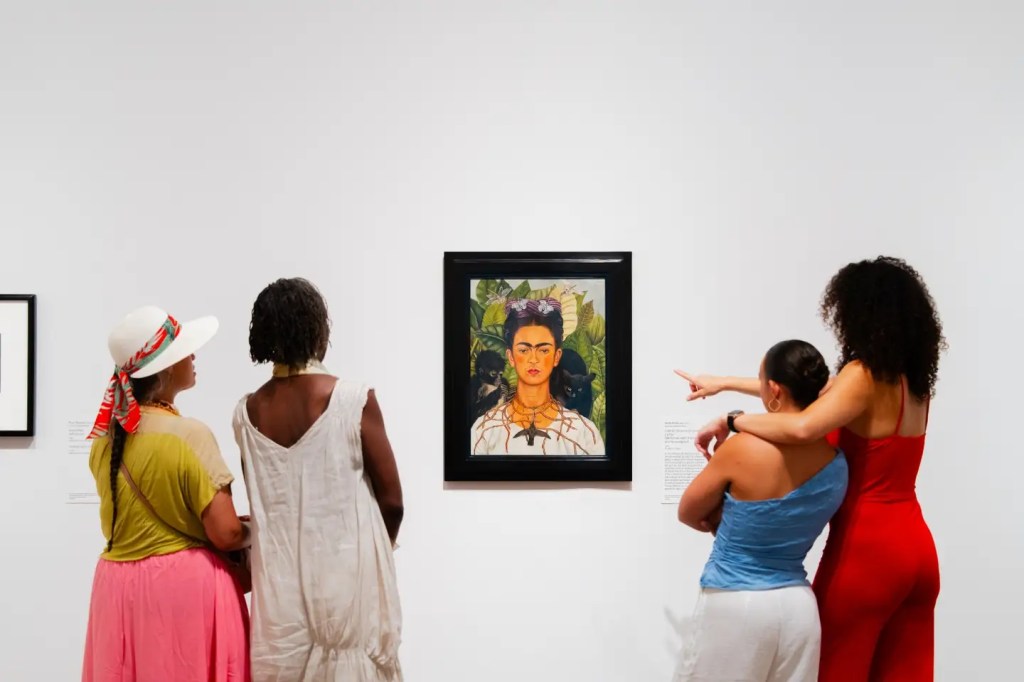
The hottest, and most contrversial, exhibition in London right now is Frida: The Making of an Icon at Tate Modern. I have been to countless exhibitions over the years but this was my first time ever seeing works by my favourite artist, the revolutionary Frida Kahlo. But her works are only a small part of this innovative exhibition which seems to be more about Frida the icon than Kahlo the artist.
Frida is, at its core, a celebration of the life and legacy of Frida Kahlo, which allows visitors to discover the extraordinary story of how she became one of the most influential artists of all time, a cultural phenomenon, and an internationally recognised commercial icon. But at what cost?
Whilst the exhibition only has a few of her most recognisable works, it offers a diverse selection of 30 pieces of her work, many of them recognisable to true fans of the artist. They have been expertly collected and displayed, introducing audiences to her many selves, such as the dedicated wife, the modern artist, and the political activist.
Alongside treasured garments, jewellery, photographs and memorabilia, there are over 200 works by her contemporaries and the artists she inspired from later generations, celebrating her lasting impact on those who continue to reimagine and reclaim her remarkable story. The exhibition takes visitors on a journey, from the artists who inspired Frida to the artists she inspired, from painters to photographers, right up to today, culminating by exploring “Fridamania” i.e. her transformation into a global brand, featuring more more than 200 commercial objects that encompass her art, image, style and persona. This part of the exhibition offers a fascinating insight into the transformative power of Frida’s life and work, the intriguing notion of fandom, and the diversity of communities who claim her as their own.
On the latter point, I am reminded of a topic explored in American Gods, in which there are various Jesuses, of all different backgrounds, as different communities imagine that Jesus, the perfect being, looked like them, and they all resonate with his inspiring, tragic story. In this exhibition, we see the same thing done to Frida, which captures her legendary, Goddess-like status.
However, the photos and paintings inspired by Frida, and the paintings that other artists did of Frida, lack the charm and charisma of her own self-portraits. Whilst Frida’s art is very different to Van Gogh’s, both artists are known for their exceptional self-portraits, and few artists captured their own pain and misery as well as the two of them. Whilst I don’t necessarily love the works of Van Gogh (though I appreciate their brilliance), like I do Frida’s, they evoke a great emotion in me; I can feel some of his suffering just by looking at them.
Whilst other artists have attempted to capture and channel Frida’s pain, but also her joy, into their paintings of her, they lack the authenticity to truly make you feel, especially when paired alongside works by Frida herself. There are also some self-portraits by other artists, some of them clearly inspired by Frida, and even some by Frida’s contemporaries, who had similar inspirations to Frida, such as Olga Costa and Maria Izquierdo (who were exceptionally talented, but Frida was in a league of her own).
Whilst it is Frida’s dramatic self-portraits which mesmerise the most, her other works are nonetheless captivating. Some of the works displayed are absolutely heart-wrenching, especially the ones where she directly addresses the tram accident that disabled her. Then there is a self-portrait which stands out amongst the others, not because it is more striking – on the contrary, it’s the opposite, for Frida, who is visually best-known for donning a pin-up and flower crown, literally lets her hair down, showing a different side to one of the most recognisable faces of all time; we see the human behind the icon.
This exhibition stands out as it explores the life cycle not only of an artist but also a legacy, from the origin of her inspiration to how she continues to inspire. But there is something a little troubling about it, and perhaps that is the point. Her image and fame are completely broken down, in a way that I have not seen happen to another artist, and her works disappear about halfway through, replaced by homages and, eventually, merchandise. It would be cynical to think that the exhibition has been curated this way merely to transform a small collection of actual Frida Kahlo works into a full-scale exhibition, stuffed full of context, made up mostly of works by other people. The curator has instead attempted to tell a story, and perhaps a cautionary tale, about an artist who arguably became too famous.
Whilst the exhibition celebrates the lasting influence of Frida, its oversaturated collection of commercial works at the end, with artists and photographers copying her face, or even dressing up as her, cheapens and dilutes Frida’s revolutionary approach to art. But this might just be the cynical, cyclical point that the curator is cleverly making about the commercialisation of art and the tragedy of those rare artists who become cultural icons and are thus commodified by that.
But one wonders if the best way to tackle this tragedy would be to just ignore all of that air altogether and focus solely on Frida Kahlo herself. This exhibition arguably focuses too much on the icon and not enough on the artist, in spite of trying to capture how Frida’s icon status has cost her some of her authentic identity. The curators have interestingly given the artist a mononym, like Madonna, which captures this commercialisation (or perhaps, ironically, because it’s trendy, catchy, and looks good on posters).
Whilst I enjoyed this electrifying exhibition and appreciated its bold narrative, I feel immense envy towards those who got to see 80 of Frida Kahlo’s works (almost half of her extant works) at the Tate over two decades prior.
Frida: The Making of an Icon runs at Tate Modern until January 3.
Photo: Tate © (Liam Man)

