★★★☆☆
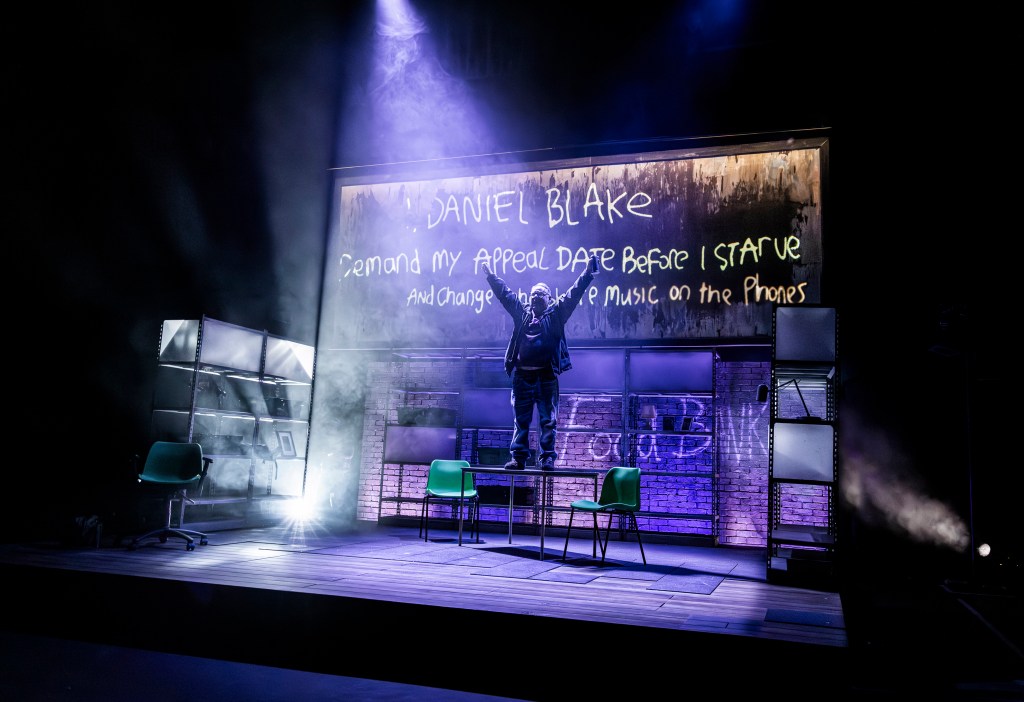
The film Daniel Blake was originally directed by Ken Loach and written by Paul Laverty. The stage adaptation is currently on tour across the UK, showing an honest look at the current Universal Credit system and its many failures. This play was adapted for stage by Dave Johns and directed by Mark Calvert. The piece is utterly devastating and hauntingly realistic though there is room for improvement with the structure and staged choices.
I, Daniel Blake follows the life of Daniel Blake and his relationship with a mother and her daughter, the current Universal Credit System, his neighbors, and his own grief. This is not just one story, but a story of over 14.3 million people in the UK who live in poverty.
The play begins with audio recordings of various politicians discussing the benefits and withdrawals of Universal Credit, taken from a debate format and displayed as ‘tweets’ on the stage wall. This set up a precedent for modern theatre elements that was not met by the direction of the show. The play included transitions and slight movement that could have worked well with the dramatic elements of the show but felt only half-developed. The transitions from scene to scene were slightly too long and took me out of the story at various points. Additionally, the overlapping audio recordings from politicians never felt aligned to the story and were lacking a clear thesis point.
The overall structure and design of the show felt both rushed and long, not allowing for a full emotional depth to be explored with the characters. For example, the neighbor of Daniel Blake had a storyline with no clear resolution or intent, making his involvement completely irrelevant to the plot. I also took issue with the neighbor opening Act II with a rap about his shoe importing business, as it felt completely misaligned with the intent of the show.
With regards to the writing, the play felt it was trying to cover every element possible from the movie, sacrificing important elements of emotional development to do so. For example, the focus on Daniel Blake meeting with his case worker over and over again, could have been done over the phone, isolating him in the story more. However, the transitions were overly long between scenes that did little to move the plot forward. For me, a significant restructuring and development of the script would need to take place. I felt the stories of the ensemble were left unfinished, and some of the emotional moments, in particular when a man yells at Daniel Blake for saying he needed benefits, lacked the necessary amount of context and relationship building between the two.
The actors were the shining stars of this piece, particularly David Nellist (Daniel Blake) and Bryony Corrigan (Katie Jenkins), who provided absolutely jaw-dropping testimonies to poverty and the extreme pressure to fight a system stacked against you. Nellist delivered emotions so intense, I felt myself moved to tears at his silent crying. Corrigan delivered a deeply impactful and sensitive performance of a young mother who is at her limit, but still trying her best. Additionally, the ensemble of Micky Cochrane and Janine Leigh also delivered excellent performances ripe with emotion. Finally, the two supporting characters, played by Kema Sikazwe (China/Ensemble) and Jodie Wild (Daisy), were excellent comedic relief characters that felt like a breath of fresh air.
I was blown away by Nellist and Corrigan, who were absolutely phenomenal in their diction, emotional cadence and conviction. Watching these two explore their emotional depth and reactions on stage was delightful. I was moved to tears in the second act, several times, reflected in the rating of this piece.
The design did little to elevate the piece, and the style was extremely minimal. This is for both costumes and lighting design. However, the use of simplistic set pieces was fitting to the story. The design felt almost half-complete in its conception, however, this could be an intentional choice to showcase the level of poverty the characters existed in.
I felt the show was excellent in its emotional intensity and acting portrayals, making this show worthy of a watch. However, I did feel the choice to include contemporary theatre elements did not align with the outcome of themes in the show. I think a redirection to classical theatre and complete restructuring of the script to include more emotional building between characters would be needed to weave this story together.
Thank you to HOME, which always provides an absolutely excellent evening from those greeting you at the door, to the hospitality team, and to the theatre itself; there is not a better night in theatre.
I, Daniel Blake runs at HOME (Theatre 1) until April 25 and ends its UK tour at Leeds Playhouse (Courtyard) from April 28 to May 9.
Photo: Pamela Raith

 JADAR
JADAR 