★★★☆☆
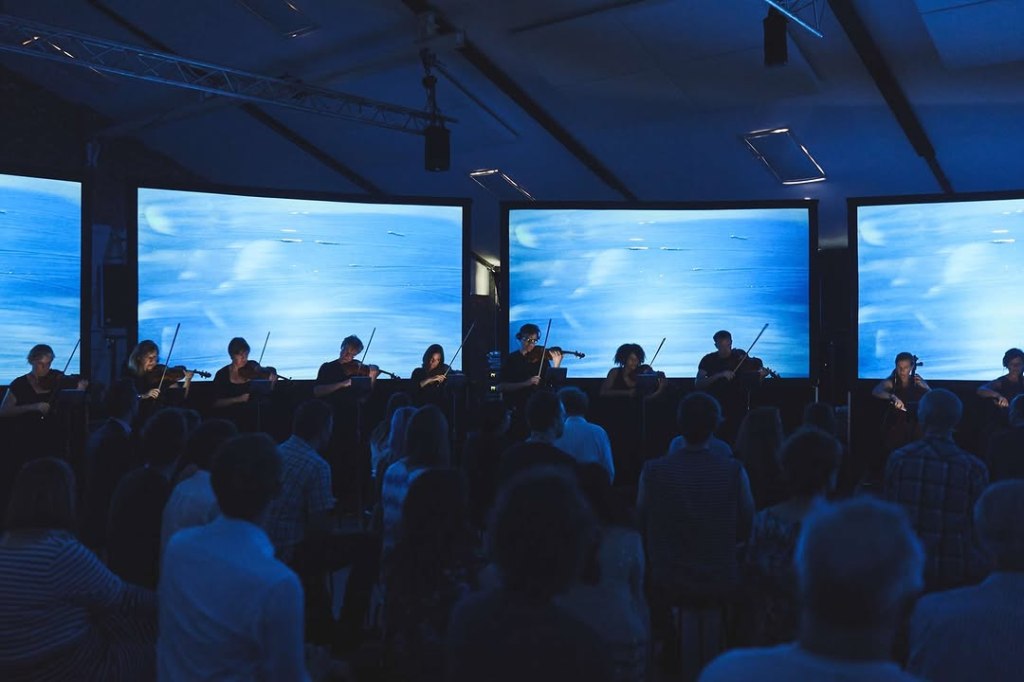
ANNO was composed by Anna Meredith as a recontextualisation of the infamous Four Seasons by Antonio Vivaldi, which guides audiences through a seasonal year. ANNO is an attempt to immerse audiences into a techno-EDM meets classical music landscape. This performance took place at Factory International at the Aviva Studios Warehouse with the spell-binding Hallé Orchestra.
It’s always a joy to watch the Hallé perform, and this certainly raised the bar for their musical performances. In particular, Roberto Ruisi (Hallé Orchestra Leader) and Zoe Colman (First Violin No.4) were particularly captivating and provided a spectacular rendition of one of the most incredible pieces of music of all time. Ruisi is a captivating artist and truly made this concert his own.
The players of the orchestra conduct themselves to perfection at every opportunity and this was no exception, despite the more immersive conditions they performed under. The show takes place in a warehouse, with the only light coming from the musicians’ tablets and the visuals on screen behind them. I knew this was not going to be my grandmother’s orchestra when the entire orchestra walked through the aisles playing a soft haunting chill. The show demanded immediate presence from the audience and put the players into a performance artist role. This had varying levels of success, as the code switch from musician to performer is a hard one to perfect.
I was starkly aware of the difference from the orchestra and it almost felt uncomfortable, watching as they slowly paced onto the stage, timidly finding their standing spots. There were clearly technical points that pushed the artists out of their comfort zone but this did create a critique on our reliance on technology. One notable realisation for me was the lack of conductor in this piece but it seemed to be led by Ruisi via a click-track system. This was remarkable to watch, and I loved seeing how he would subtly transition tracks throughout the program.
The core thesis of this piece seemed to look at our rising dependence on technology and overall consumption of media. The music seemed to be battling between the classical instruments and chirpy technical additions, swelling, fighting, melding, before almost rejecting one another. To me, it was a harsh depiction of consumption, over-dependence on technology, and the fight to immerse ourselves in our history. This was solidified for me when the concert ended with Ruisi, standing along on stage, playing a chilling final note while slowly exiting the stage. It felt like a representation of a tortured artist, finding the balance between the single imagination of a human and the necessity of a village to portray it. The foundation of the show seemed to rest at the intersection of classical music and new sounds, exploring a world where they exist together. The swelling and erratic pulsing of the additional sounds was overwhelming in moments and stunning during others.
Classical music markets itself to a particular audience and environment, this can lead to it being an extremely exclusive environment for many. Though the music itself is made to encapsulate the wonders of life and love, the environment can often be one that is gatekept. The Hallé and Factory International do an exceptional job to eliminate barriers in terms of financial stressors, offering a range of concession tickets. However, with the additional graphics and visual material, I felt this production regressed on their intention to involve younger audiences and instead isolated particular audiences members even more with the intense use of confusing graphics. The visuals had little basis or purpose that can be found and instead acted as distractions. In particular, there was a section of music where a green blob grew into a small moving character that crossed across the stage multiple times. For me, it felt like the visuals were not well researched or had any foundation in theory, like the rest of the production seemed to have. The disconnect from the live music and from the original score did not blend well.
The concept of this show was spectacular, asking all the right questions. How can we combine classic music with new age sounds? Is it possible to have these worlds battle, and how do we dictate a winner? The concept fell short in its visual components and almost pushed audiences away. I think further development to link together all elements is needed, for example, having visuals that surround one concept as opposed to several art styles and repetition of motion.
Photo: The Hallé
 JADAR
JADAR 