By Katie Bray and Jay Darcy
★★★★☆
Many people’s first introduction to Anne Lister was her portrayal by the always amazing Suranne Jones in the hit TV series Gentleman Jack, her dapper period attire sparking fascination (despite our general disinterest in the trivial pomposity of certain period dramas). The award-winning Gentleman series, which was based on the secret diaries of Lister, sometimes referred to as the “first modern lesbian”, has now been adapted into a ballet by Northern Ballet.
It’s a unique glimpse into 19th century intersectionality, with bigotry attempting to suppress feminine agency, queer expression, and homosexual relationships.
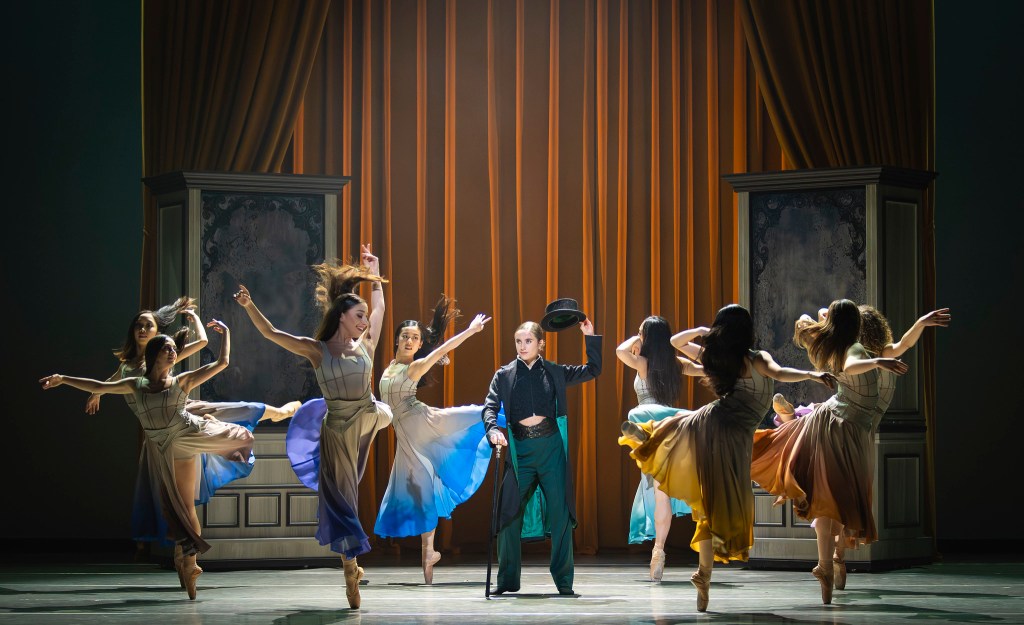
Annabelle Lopez Ochoa’s choreography is charmingly eloquent, visually depicting societal and gender constructs with fierce flair. Most gentlemen have an air of sturdiness, strict postures and often grounded routines decorated with grand kicks and sweeping tailcoats. In contrast, the women are often poised yet gentle, their physique supply bending to their partners’ will as they’re puppeteered and paraded around. Listers’ choreography sits neatly between the two, strong posture, striking positions, swanky hip rotations, interpretive displays, and acrobatic feats.
Louise Flanagan’s costumes employ similar juxtapositions, matching floating skirts, puffy sleeves, and frilly lingerie contrasting the rigid lines of darkly coloured top-hats and pantsuits. Instead, Lister’s gentlemanly attire is lined with dazzling pops of emerald and a swaggy cane. The outliers were nude-coloured with written scribbles who represented Lister’s encoded diaries; her main source of expression represented through their moody, abstract, yet all-embracing routines. Here, the ensemble, all wearing the same leotards, appear gender-less, representing Lister’s androgyny.
Contrasting the lavish costuming is a minimalist set from Christopher Ash, chandeliers, tables, curtains, and bookcases accenting different spaces. The stripped back approach draws more attention to the cinematic collage of bookcase screens, Lister pacing in place while the environment slowly moves around her, perhaps representing her inability to control this tough world. Whilst many modern products rely on big screens to make up for a lack of set, this production simply has coloured backdrops, with screens instead placed on bookcases, which is much more dynamic.
The lighting could have had more impact to match this visionary approach, especially in the more interpretive ensemble routines. The overall lack of spectacle forces focus on the choreography but whilst the choreography takes an interesting approach with gender, the dancing itself is often quite conventional and lacking in more striking movements. Peter Salem’s score is similarly conventional and a bit samey, however, it fits the constraints of the period drama niche, with stirring orchestral accompaniments paired with playful accentuations. Other times moments of intrigue, mystique or darkness creep into the score. It’s just lacking in drama.
Gentleman Jack is a daring articulation of misogynistic control and bigotry reflected by dynamic dancing and clever costuming.
Gentleman Jack runs at Lowry (Lyric Theatre) until June 6 2026 and tours the UK until April 3 2027.
Photo: Emily Nuttall

