★★★★☆
The Royal Exchange Theatre is now halfway through its 50th anniversary “Homecoming” programme, under the bold artistic direction of Selina Cartmell, who was just what the theatre needed. The diverse year-long programme not only sees the return of classic musicals at Christmas (rather than the more niche, experimental musicals post-pandemic) but also a musical at the halfway point: the long-awaited UK regional premiere of Fun Home, which won the Best Musical award at the Tony Awards back in 2015 and and was highly acclaimed when it had its UK premiere at the Old Vic back in 2018 but was surprisingly not seen again – until now.
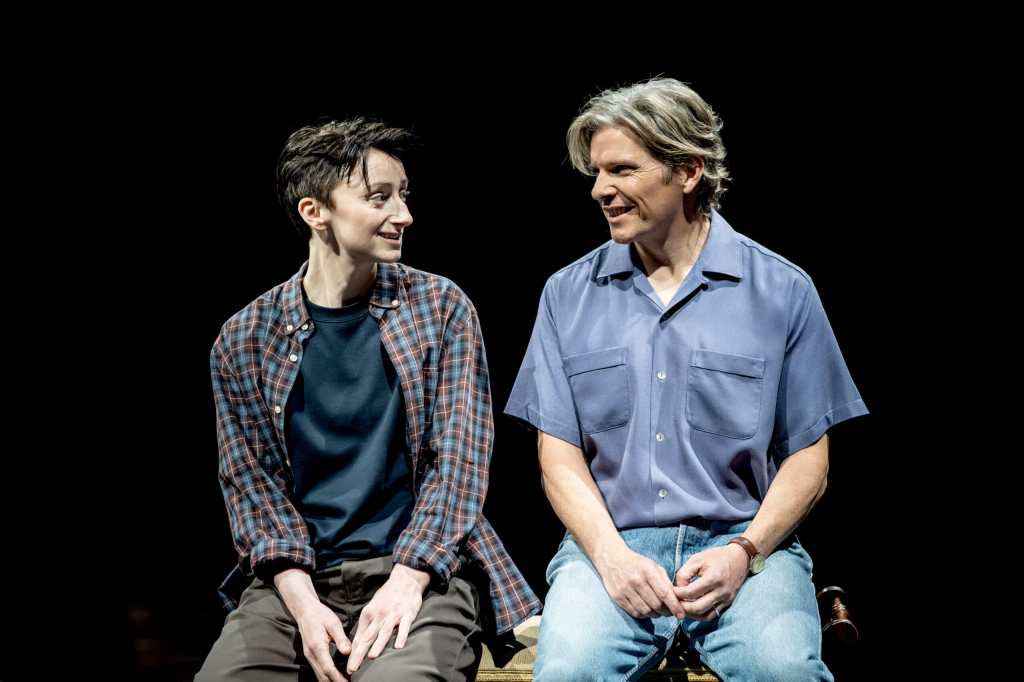
The 30th Royal Exchange production directed by previous Artistic Director Sarah Frankcom, it marks 20 years since the publication of Alison Bechdel’s graphic memoir upon which it is based. The narrative chronicles Bechdel’s youth in rural Pennsylvania, her realising that she is gay at university, and her relationship with her closeted, emotionally distant father. It explores how she comes to terms with her own lesbian sexuality just before uncovering her father’s secret life and his untimely, tragic death, which we are told about at the beginning of the show. The non-linear narrative (the novel is also non-linear) allows the audience to forget about the upcoming death, but the Alison Bechdel character (a charming Jodie McNee), who narrates the show, later tells us exactly how he is going to die, which hits even harder not only because of how horrifying his death is but also because we have know gotten to know, and love, these characters.
The father, Bruce Bechdel, is played to perfection by the always brilliant Nigel Harman, who evokes sympathy and empathy for a troubled, morally dubious character. The book, by Lisa Kron, never justifies his actions, but it allows the audience to understand the mindset of the character. It also delves into the psyche of his wife, Helen (Alex Young), who hides behind a Stepford Wife-like facade. Whilst at first she appears oblivious, perhaps knowingly, it is later revealed that she knows exactly what (and who!) her husband is getting up to – but this is suggested early on when she reacts weirdly suspiciously around her husband’s friend (played by Lucca Chadwick Patel, who skilfully plays a few characters: Roy/Bobby/Mark/Pete).
Natasha Cottrial plays the striking Joan, who is responsible for Alison’s sexual awakening. She also plays The Audrey Deys, alongside Alice Audrey O’Hanlon, whose main character is “Medium Alison”, whilst Harriet O’Shea played “Small Alison” on press night, with Reuben Shepherd and Theo Wake playing her brothers, John and Christian, respectively. It’s an exceptionally talented kid cast, with impressively believable American accents.
It’s a pretty simple, sparse set design (Peter Butler, who also designed the lovely costumes), with some set pieces, and a revolve which creates drama and tension, and slick lighting design by Bethany Gupwell – but director Frankcom has stripped things back so that the audience’s focus is almost entirely on the rich text, dexterous songs, and powerful performances.
The score (music by Jeanine Tesori and lyrics by playwright Lisa Kron) is pleasant but most of the songs blend into one, save for the catchy title number, ‘Come to the Fun Home’, which is the closest the show comes to having a show-stopping number. But this is not that kind of musical. Many consider the score to be a masterpiece of emotional depth and melodic storytelling, with character-driven songs which delve into the psyche and motivations of the characters and further the narrative, without a filler in sight. Rather than relying on traditional, overly saccharine Broadway power ballads, the score is made up of subtle, melancholic melodies and conversational, diary-like structures. It seamlessly bridges the gap between memory and reality, turning a primarily visual medium into a devastating and frequently hilarious musical landscape.
That said, the score might benefit from one or two more groovy numbers, as having ‘Welcome to the Fun Home’ so early on risks the audience wanting something of that tone and sound again – but it never comes.
Furthermore, because of the multiple timelines, without an obvious point to pause, the pacing and tone can feel slightly wearying as it grapples with heavy themes of repressed sexuality, marital discord, and suicide. But the non-linear approach mostly works very well, successfully mirroring how human memory actually works. Instead of a traditional timeline, the memoir operates like a labyrinth or puzzle, constantly circling back to the same pivotal events – her father’s closeted sexuality and his presumed suicide – to analyse them with new, evolving perspectives.
The musical – or perhaps this interpretation of it – occasionally leans into sentimentality, which is unnecessary when the script and score are already so textually, thematically and emotionally strong. But these criticisms are small, and very debatable, in what is, undeniably, another smash-hit production for Frankcom.
Fun Home is fun, fresh and fearless.
Fun Home runs at the Royal Exchange Theatre until August 1.
Photo: Johan Persson