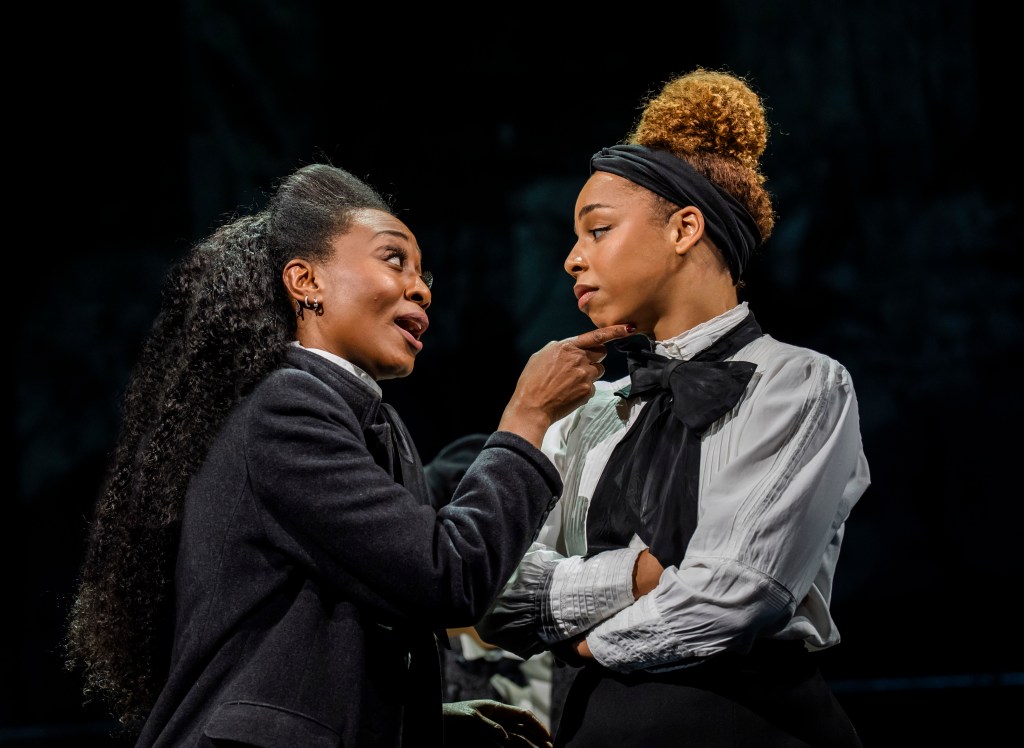
Following a short UK tour, the Olivier Award-winning Sylvia—this Olivier Award-winning production has returned to London for a few days at the Royal Albert Hall.
The production is bright, enticing and energetic, with history and passion dripping from every note. The production has a large creative team, Zoonation’s Kate Prince responsible the book, lyrics, choreography and direction. Other major contributors are Priya Parmar, who co-wrote the book, Josh Cohen and DJ Walde who created the music, and Ben Stones who worked on the set and costume.
Sylvia is a modern and energetic retelling of Sylvia Pankhurst, famous activist, feminist, socialist and artist from Manchester. With her mother and sister, Emmeline and Christabel Pankhurst, she helped to form the Women’s Social and Political Union. She stands as a remarkable reminder of the resistance and rebellion necessary to spark lasting change. Sylvia was a passionate supporter of working-class women (and men), those facing poverty, and silenced voices.
Beverley Knight revives her Oliver Award-winning role for the London production as Emmeline Pankhurst alongside Naomi Katiyo, who has replaced Sharon Rose (who departed to return to One Day The Musical), as the title character.
The most stunning part of this production is the variety of women gracing the stage. The concept is exciting and refreshing, shining through a wave of artificially curated artistic and male-centered stories we have had in media of all kinds across the years. However, the show fell flat if this promise by delivering a “feminist” musical that largely revolved around men and kept out of political standings.
It took three songs before the romantic interest for Sylvia was presented, and she declared to him she has no talent as an artist. Additionally, a large portion of the family tension was resolved in the second act by shifting all blame to Sylvia’s deceased father. The cherry on top was Sylvia’s story ending in marriage and a son that quickly wrapped up her narrative. Though, potentially, accurate to her story, ending the musical with her relationship and new motherhood felt slightly reminiscent of the nuclear family narrative we know too well. The focus revolving around the right for women to vote is a particularly interesting one, however, the ending took a turn I did not expect.
The color themes and detailed projections and costuming in the second act were red and white lines, eerily reminiscent of the England flag. In our current political standing, where the flag is being used in far right and conservative ideology as a symbol against immigrants and to represent TERF beliefs, this was a little unsettling. It felt almost incessant on nuclear family values where Sylvia is accepted as a feminist because she also got married to a man and had a child.
The musical gives a succinct history of the rights of women across the UK and covers a wide variety of topics, hitting every trigger warning in the book. A handful of these topics were not handled with enough care, including a detailed and symbolic depiction of forced feeding, though I appreciate that this dark history is often not spoken about much.
In 1918, women over the age of 30 across the UK were given the right to vote, and in 1928, this was amended to all women over the age of 21. I was impressed by the sheer volume of information included.
Interestingly, the show is called Sylvia, suggesting a heavy focus on the middle child of the Pankhurst family. However, I felt the show itself focused on the family altogether; the influence of all women, but especially Emmeline. Perhaps it is more aptly named Pankhurst.
One of the easily traceable musical theatre phenomena is the rise of hip-hop and pop music in storytelling across the last ten years,, largely due to the groundbreaking success of Hamilton, Six, and, Operation Mincemeat. For me, this combination of history and modern music can feel forced, particularly in the heavy demand for rhyming dialogue flow. I felt the decision was made more from past success of this method as opposed to genuine belief in the culture of hip-hop as a means of rebellion. The effect was a clunky rhythmic flow and awkward dialogue.
Hip-hop was a key artistic revolution in the United States that centered Black and Hispanic youth across New York City in the 70s while funk belonged to largely African-American communities with origins from the 1960s. Whilst Zoonation is a hip-hop organisation, I found that this show used the musical stylings of hip-hop and funk as musical tactic as opposed to designated interest in the pursuit of narrative. There is little connection in the story besides both connecting to the rejection of oppression.
The musical stylings of the show are repetitive and lack variety/difference from one another. I found the sung-through nature of the entire production to feel forced, the necessity for rhyming reflecting greater importance than narrative sense. For example, how many times can they rhyme “condition” with “condition?” I counted three in a row.
Hip hop and funk have a strong tie to political activism across the world, and though it feels slightly disjointed to this production, I would love to see this show expand on current problems facing women, disabled individuals, queer folk, and those facing other systematic disadvantages, leaving audiences with a call to action as the show ends. I felt this needed more than saying, “But what about the rest of the working class?”.
Historically, women’s and queer rights in the United Kingdom are messily intermingled, and this show shied away from this. Whilst credit can be given for making Christabel queer, as there had been rumours, this lesbian love story is mostly overlooked. While Clementine and Sylvia got full swooning love songs (multiple times), Christabel was easily forgotten with a “oh, you look cute” to her female friend and a quick kiss before the first act ends (strategically juxtaposed next to her dead brother, how romantic!)
I felt the overall sense of narrative was confused, jumpy and intense. The structure would benefit from a serious narrative cut, focusing on one to two important elements as opposed to focusing on grief, death, politics, political parties, art, school, and a handful of other themes.
There is also importance in exploring difficult themes in an approachable manner, making music an ideal platform to champion successes and exposing vulnerabilities.
I felt some of the the themes almost fell flat. There were a few moments I felt genuinely touched, moments when community and femininity were showcased on stage, but a large chunk of the production left me feeling isolated and confused. The production felt like it was fighting two simultaneous wars: one being man vs woman and the other being violence vs peace. Both of which demanded better solutions than “fall down seven times, stand up eight” and “be the change you wish to see.” The inability to dive deeper into these very nuanced issues speaks to a much larger issue in the industry where non-political stories are taking the spotlight. Art should remain political. To me, this production shied away from making any formal statement, making it a difficult watch. Why this story? Why now? For me, they did not have an answer to this.
The choreography and direction felt like there was a lack of intent in the production. I felt let down by the choreography which lacked variety and the distinct lack of any directional viewpoint related to the story and musical themes. The show fell victim to a handful of issues I see in modern musical theatre, often leaning towards a favor of spectacle over genuine love for the marriage of acting, music and choreography.
The absolute lifeline of this production were the astonishing singers gracing the stage. Naomi Katiyo is absolutely brilliant in her role as Sylvia, with a beyond gorgeous voice. Beverley Knight stars as Emmeline Pankhurst with an absolutely brilliant vocal performance. Collette Guitart (Clementine) delivered an impressive vocal performance fit for the Royal Albert Hall.
The show is absolutely hit and miss, and I understood that other people absolutely loved it (including our Manchester reviewer, Katie Bray, who gave it a full five stars). It is high energy and quick, which can make it very entertaining. I felt confused about the intended audience but believe it could be a very interesting piece for kids to watch. The simplification of themes and the clunky musical format was what turned me away from the show.
Historically, the Royal Albert Hall was home to several Suffragette rallies and speeches, crucial to the fight for women’s rights to vote. However, the Royal Albert Hall temporarily banned women and Suffragettes from the hall between 1913 and 1918, which included the temporary ban of the Pankhurst family. The history is crucial to the context of the current political landscape and allows for an excellent return to the site, where Sylvia Pankhurst herself once spoke.
Sylvia runs at the Royal Albert Hall until November 15.
Photo: ©Tristram Kenton

