The Spy Who Came in from the Cold is not only the first-ever stage adaptation of the best-selling novel of the same name (which was adapted into an award-winning film) but the first stage adaptation of any novel by acclaimed English author John le Carré. Whilst that might be surprising, especially because his work has been adapted to the screen, both big and small, numerous times, this production suggests that his complicated novels do not translate so well to the stage.
The Spy depicts Alec Leamas, a British intelligence officer, being sent to East Germany as a faux defector to sow disinformation about a powerful East German intelligence officer. As with le Carré’s previous novels Call for the Dead and A Murder of Quality, the novel features the fictitious British intelligence organisation, “The Circus”, and its agents George Smiley and Peter Guillam, though the latter is cut from the play, which wisely streamlines the narrative.
David Eldridge has done a decent job of adapting the novel for the stage, making it as easy to follow as it can be without reducing the narrative too much. However, it is, inevitably, stuffed full of information, exposition, and context, which makes for quite a dry watch, lacking in momentum and tension, despite the many twists and turns. I imagine the novel is pretty thrilling to read, and big-budget screen adaptations can be stylish and innovative to keep the heavy plot interesting – but it is much harder to do this onstage, especially with a small budget (which seemed mostly to go on casting Ralf Little).
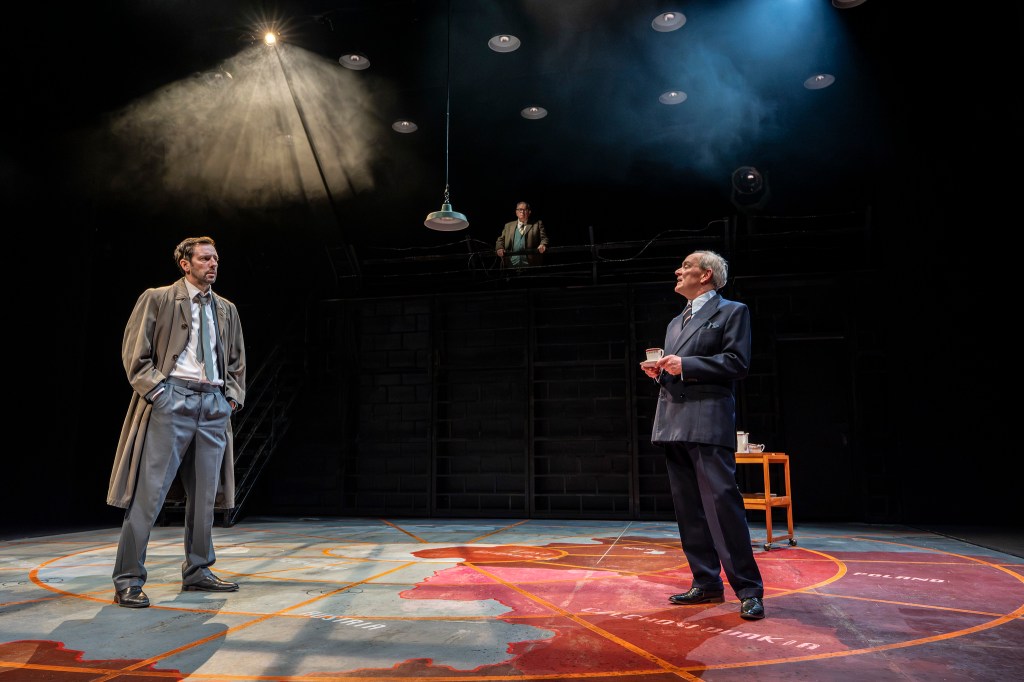
This adaptation has unsurprisingly integrated the iconic George Smiley (Tony Turner) into the narrative more directly but it feels forced, especially because the direction and design make a big deal every time he appears onstage; this should only have been done the first time. The first few times he appears, he is on the top level, imagined by Seamas, who sees him in multiple hallucinations, which are overused. One or two other characters also appear on the top level when spoken about, which feels a bit obvious and overly dramatic, especially in a play that is otherwise lacking in drama, not only because of the exposition-heavy book but also the dated direction and dull design.
The production is so visually uninteresting that there is nothing to keep the audience engaged, resulting in many people switching off and then feeling lost. The production would have benefitted from a more elaborate set, or a more ambitious, abstract, artistic design, which could have still been minimalistic. There are some abstract elements in the production, which feels quite black-box-studio, and there is some nice lighting by Azusa Ono, but the flashes and beams of coloured lighting feel quite clichéd. The production, as a whole, is unimaginative, uninspired, and pedestrian.
Paul Englishby’s compositions are aurally cinematic. They heighten the drama and tension in a play that is otherwise quite static. But this contrast sometimes results in them sounding melodramatic and out of place.
There are some good performances but even the best actors would struggle to succeed in this production. Ralf Little performs well but is not entirely convincing as, and never fully inhabits, the broken, damaged Leamas. Whilst some might put this down to him first-and-foremost being a screen star, he is actually an accomplished, Olivier Award-winning theatre performer, which suggests that he has just been miscast and/or improperly directed in this role – as refreshing as it is to hear a Northern accent in a stage adaptation of an acclaimed, quintessentially British novel.
The Spy Who came in from the Cold runs at Lowry (Lyric Theatre) until July 25 and tours the UK until August 22.
Photo: (c) Johan Persson