★★★★☆
30 years after the premiere of the ground-breaking British-Pakistani play East Is East, Octagon in Bolton have mounted a brand-new production, directed by Kash Arshad.
A semi-autobiographical play by Ayub Khan Din, East Is East follows the trials and tribulations of a working-class, mixed-race British-Pakistani film in the 1970s. Whilst the play premiered in Birmingham, it is set in Salford, Greater Manchester. Staging it in Bolton feels close enough, as it’s another Greater Manchester city with a substantial Pakistani population.
The play is largely about a clash of cultures. The children are not only British-born but also mixed-race, forcing them to operate in a liminal space of (not) belonging, thanks in no small part to their tyrannical, conservative father, George – who wants his kids to be culturally Pakistani despite moving to the UK and marrying and having children with a White British woman.
Whilst George has his issues, including domestic abuse towards both his wife and children, the play never vilifies him, nor does it justify his actions, but it allows us to understand why he is the way that he is, and it’s evident that he loves his family and wants to protect them. Bhasker Patel does a wonderful job of highlighting the nuance and moral ambiguity of a character which could easily be a conventional antagonist, or which a lesser actor might turn into a caricature.
Samantha Power is completely captivating as George’s hard-done-to wife, Ella, who has put up with so much but is at her breaking point, not only because of her difficult husband but also her troublesome children.
The eldest child, Nazir, is unseen, as he fled the family before the start of the play, to escape an arranged marriage. I think that this adaptation does not mention that Nazir is, in fact, gay – or it was so subtle that I missed it. This might be because of issues with the way that this has been handled previously but it’s a shame to just do away with it rather than handling it with more sensitivity. But we should also not shy away from the harsh realities of history: it will have been hard enough being gay in the 1970s, let alone in a conservative Pakistani Muslim family.
The next eldest brother, Abdul (Danyal Ismail), is forced to take on the mantel (and pressure) as the eldest son. Whilst he dislikes much about his father, he has too much respect for him to challenge him.
However, the next son, Tarik (Zaki Ali), is the polar opposite, completely dismissing his Pakistani identity and being, frankly, racist to his own people. He is later called out for mocking his dad with his White friends, as his White friends are actually laughing at the “half-cast” kid. The play could certainly have explored this self-hatred in more detail, as well as the difficulty of growing up brown in 1970s UK. My parents have told me how our area would turn into something of a sun-down town, where racist punks would go out “Paki-bashing”.
Maneer (Joeravar Sangha) is the most religious of the children. Through him, we are shown a positive side of religion. Whilst he has willingly embraced Islam, he openly criticises his father for forcing his religion and culture upon his children.
Saleem (Matthew Khan) is the artist of the family. South Asian parents often want their children to choose “professional” careers – because they want better for their children but also, sometimes, because they care too much about what others will think – so Saleem represents that friction but, again, it could have been explored a bit more. In the film, Saleem was played by Chris Bisson, who had previously starred in the play – and was there on press night, which was a nice touch.
The only daughter is Meenah (Maya Dhokia), who has less freedom than her brothers, but this is not really evident; Ella just criticises George for it towards the end of the play. Despite this, Meenah is not merely a victim, as South Asian and Muslim women are often portrayed to be; she’s incredibly strong, proud and feisty – which is, actually, much more reflective of South Asian and Muslim women!
The youngest child is, of course, Sajit (Rohan Macleod), who we now understand as being neurodiverse or having a learning difficulty. This feels very relevant 30 years later, as we have become much more open about these things today, and it is so normal for kids to talk openly about their conditions and mental health.
The film lifted a lot of dialogue directly from the play. The audience seemed thrilled to hear some of the iconic lines, such as “The Pakis are here!” The racial humour provided a mixed reaction for many non-Asians in the audience, some of them seemingly unsure of whether or not they could/should laugh. The funniest scene was, of course, the “fanny” scene, which I had actually blocked out of my memory, having been traumatised seeing it with my parents as a child! But this play means a lot to me because it’s the foremost piece of British-Pakistani pop culture. Whilst both my friend, Danny, and I are third-generation (he’s also mixed-race), and thus the events of East Is East are not our reality, some of the things that happen in the play sound shockingly close to stories that my parents told me – even if they are heightened for dramatic effect.
I do worry, however, that the play might reinforce some troubling stereotypes, by leaning into oversimplified tropes, from the tyrannical Muslim patriarch to the submissive wife. People have a habit of seeing one minority do something and thinking that all minorities do that thing. A lot of White people will watch East Is East and think that that is the reality for all British Pakistanis, which it is not – but it is, or was, the reality for a lot of British Pakistanis back in the 1970s, and that cannot be ignored. After all, it’s partially based on the writer’s own upbringing, and he has to be true to himself. We cannot dismiss these things because they make our community look back. If we want White people to acknowledge their racism, we, too, must acknowledge, and tackle, issues within our community.
There could be further nuance, such as challenging George’s (and lots of Muslims’) misogyny with the reality that Islam actually championed women’s rights and was in many ways proto-feminist – but this has been perverted by patriarchy to suppress and oppress women. However, a play can only do so much, and it does not want to be overstuffed.
That said, there are a few pacing issues, and the runtime could probably be cut a little bit, but it picks back up in the later part of the second half, turning into a real rollercoaster. It’s a brilliant climax to a very dramatic domestic drama.
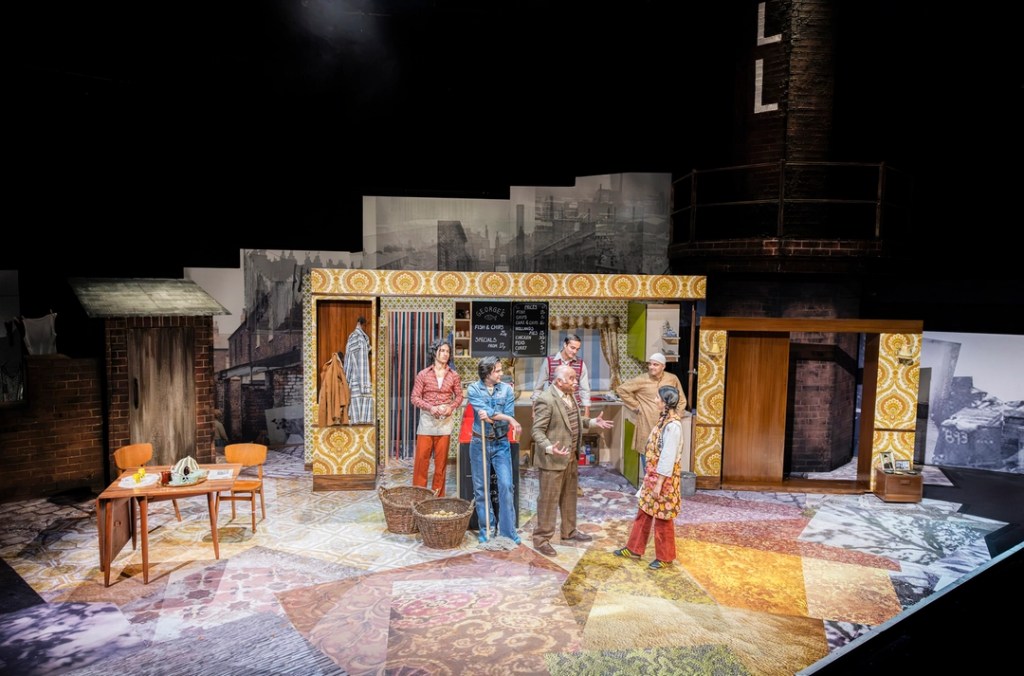
It’s not only the writing that feels authentically Asian but also the design by Rachana Jadhav. The set and costumes alike feel very 1970s British Asian. There are lots of scene changes in the play, which Arshad handled effectively through seamless set changes, such as bringing parts of the walls forward to turn the house into the chippy. Jane Lalljee’s lighting also aids in scene transitions, with the warm, yellow lighting of the home contrasting with the harsh, white lighting of the chippy. In the penultimate scene, the play repeatedly switches between the kitchen and the living room, with lighting flicking between the two so the audience know where to focus.
This production ultimately proves why the play still resonates three decades on: it’s messy, funny, painful, and deeply human. Arshad’s production honours the original’s raw honesty whilst giving it a fresh emotional charge, helped by a cast who understand that the story’s power lies in its contradictions: love and violence, belonging and rejection, pride and shame. Despite a few pacing issues and moments that could benefit from deeper nuance, this revival captures the chaotic tenderness of a family caught between cultures and generations. It’s a vibrant, heartfelt reminder of how British‑Pakistani stories have shaped the North’s cultural landscape, and why they deserve to be told with both affection and complexity.
Before the play, Danyal Ismail previewed another British-Asian play about marriage, Egging, by Adam Kotwal, which was first seen at Octagon as part of MACFEST last year and will return next year. Ismail’s delivery was both earnest and hilarious, and I hope I get to catch the full play.
East Is East runs at Octagon until October 3 and tours the UK until November 14.
Photo: Pamela Raith Photography