Before Ahmed Masoud had even published his story about Gaza accidentally and unexpectedly hosting the 2048 Olympics, a decade after the Nakba, he was asked to turn it into a radio play to be aired every Olympics. However, he did not receive his royalties in Paris 2024, later being told that it was not used because it was too political for the moment. This insane response led him to turn it into a stage play, premiering last year in London, as part of both the Shubbak and Palarts Festivals (the latter of which he founded), ahead of a UK tour this Autumn.
Application 39 is an example of speculative fiction, a genre which asks “what if…” and explores alternative realities, futures, or technological possibilities, based on actual history and reality. Indeed, this play, though speculative and hypothetical, is rooted in testimony. As Masoud told us at the pre-show Artist Talk – in which he and director Cressida Brown were interviewed by Zena Agha, who is herself part Palestinian – he even used testimonies by his own family. Whilst Masoud fled Gaza years ago, his family is still largely located there, and by the time the play was first presented last year, 13 members of his own family had already been killed, including his older brother, Khalid. Then, during rehearsal, his brother’s wife and his 17-year-old nephew were murdered in an Israeli airstrike – the very nephew whose testimony of Israeli military detention forms the backbone of Rayyan’s monologue in Act III.
A dystopia, Application 39 imagines a stabilised ceasefire, in which the Palestinian Territories have been divided into various states. Whilst things are ostensibly peaceful, the President of each State has been appointed by Israel, and Palestinians are monitored incredibly closely, largely by robots who will shoot them on the spot if they fail to provide documentation. Without giving too much away, there is a very interesting scene in which the protagonists cause a robot to malfunction by questioning and challenging its reality, which feels very relevant today, what with the terrifyingly rapid rise of AI and intense surveillance, much of it secret.
A sharply satirical, future-facing drama, Application 39 imagines a Gaza risen from ruin, unexpectedly awarded the right to host the Olympics, after two siblings, both IT workers, submit an application, fraudulently signed by the President of Gaza, because they found it funny but also to challenge hegemony and mainstream systems, which is exactly the purpose of this play.
In fact, Palestinians being silly itself challenges those things. Indeed, whilst the play sounds serious, and indeed the topic is itself very serious, Masoud is known for his darkly comic writing style. This itself challenges narratives around Palestine, the Middle East and war. Even during a genocide, Palestinians find ways to live their lives and have fun, including watching football matches during the World Cup. The power of sport, in which it brings people together, and its popularity in Gaza, is one of the reasons Masoud chose to set this play during the Olympics.
Sci-fi also challenges preconceptions and narratives about the Middle East. At an Iranian artist talk at Factory International back in May, Javaad Alipoor told me that he uses sci-fi and glossy aesthetics to tell stories about Iran, and the Middle East more broadly, for that very reason. I am also reminded of the satirical sci-fi short films by Palestinian filmmaker Larissa Sansour, in which she located Palestine on both the moon and in a skyscraper, upon which I wrote an essay and part of my dissertation during my Masters.
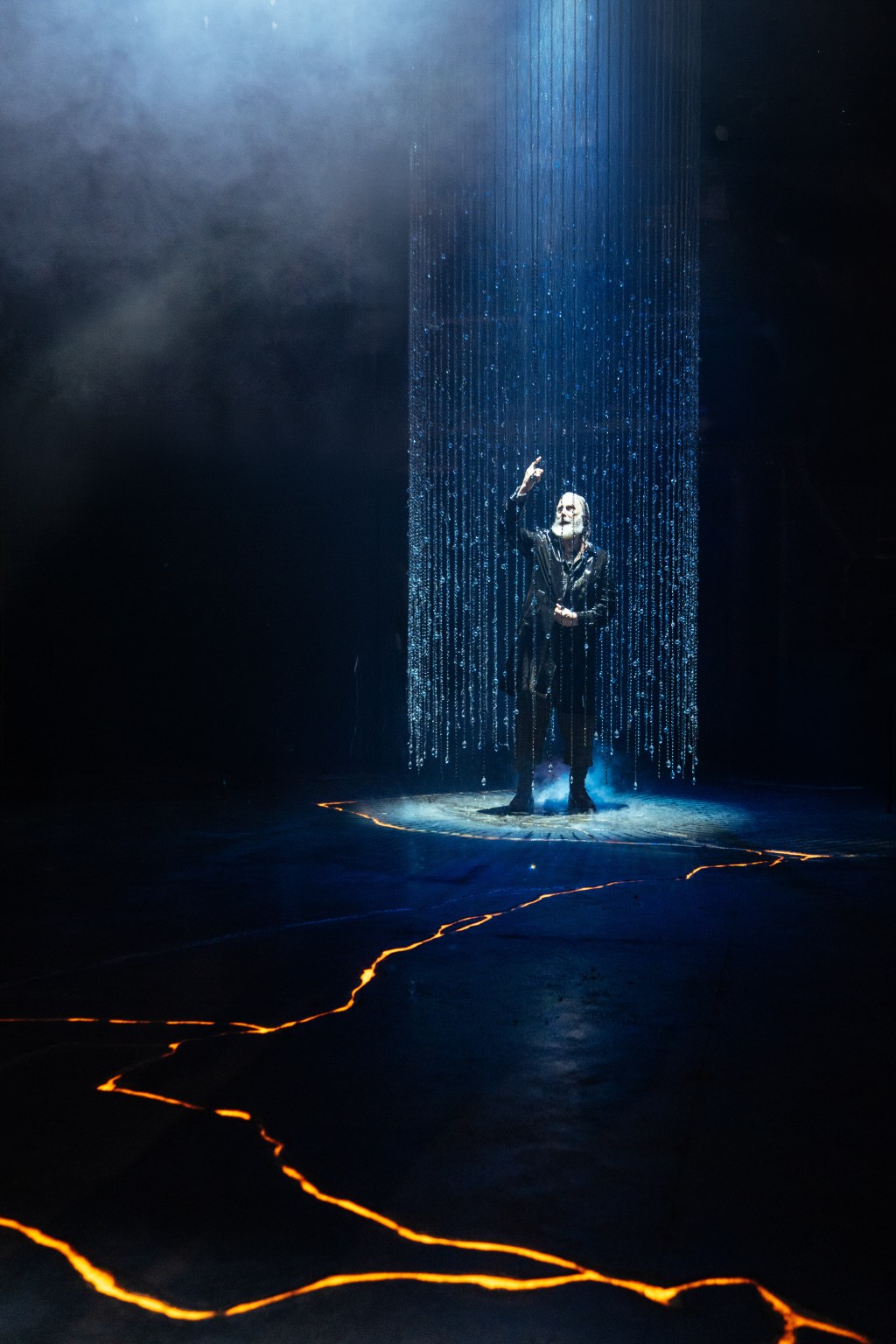
Set Designer Charlotte Espiner’s cold, clinical, empty staging draws attention to the medium of theatricality, highlighting that this is merely speculative, albeit based on reality, and perhaps signalling that the actual future could be very different, for better or for worse, depending on what happens in the present and what we do right here right now. She strips her set, and her costumes, of any form of orientalism but also refrains from a glossy aesthetic, which I half expected, as Brown has opted to keep things dark and gloomy, contrasting the sci-fi genre and narrative with bleakness. Imogen Clarke’s lighting is very dull and intimate, whilst Sami El-Enany’s compositions are dense and heavy. There is a feeling of being weighed down, capturing the lack of freedom for Palestinians, whose every move is watched and every decision is interrogated.
However, it does become difficult to stay laser-focused when everything is so visually dark and simple. It would have been great to see some more dynamic lighting and perhaps even some projections and video designs, but I appreciate the simple, minimalistic approach and its intentions.
The cast is made up of four passionate Palestinian performers – Nadia Dawber, James El-Sharawy, Selma, President – who are not merely acting but also channelling their own experiences. It must be emotionally exhausting reliving their trauma night after night but also cathartic, especially by the time the harrowing play reaches the extreme generosity and radical hope of the play’s final message.
Application 39 ends its UK tour at Stratford East from October 13 to 14.