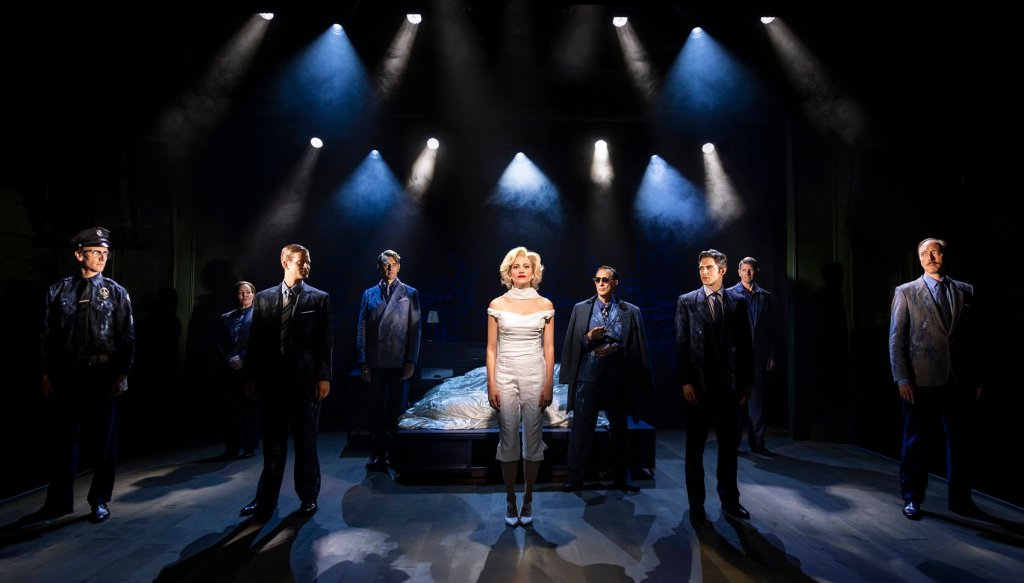
One of the most prevailing conspiracy theories is that Marilyn Monroe did not commit suicide, or die by overdose, but was in fact murdered, be it by the Mob or the Government, perhaps the FBI or the Kennedys. Who Killed Marilyn? is a brand-new play, written by Sharleen Cooper Cohen and directed by Philip WM. McKinley, which unashamedly explores conspiracy theories surrounding the suspicous death of the most famous woman in the world.
Who Killed Marilyn? is being performed at the Emerald Theatre, the newest theatre on the West End, located in the old Proud Embankment building. It thus has a cabaret feel to it (indeed, the theatre opened with a disastrous Dita Von Teese show), which is perfect for this show, as it references the sexy showgirl aspect of Marilyn’s life but also the intimacy and secrecy of showbusiness. It feels very behind closed doors, like the curtain is being pulled back to reveal all about Marilyn’s life.
We were kindly sat on the luscious sofas, which is such a nice touch, but as an insomniac who sometimes feels himself wanting to fall asleep at the theatre, they could be dangerous – especially if you find yourself bored!
The play is narrated by the spirit (or something) of Marilyn Monroe. There are two linear timelines. The play opens with Marilyn being found dead by her housekeeper and the immediate aftermath of this, which it keeps coming back to, whilst Marilyn takes us through her best-known romantic relationships, from Joe DiMaggio and Arthur Miller to the Kennedy brothers, as well as some platonic relationships. The back-and-forthing is pretty slick but Cohen could have made stronger parallels, linking scenes past and present.
We are almost immediately told that Marilyn was murdered – but not yet by who. The play, then, becomes something of a murder mystery. But it lacks the suspense and intensity required for a thriller. It’s a real slow burn, and this pacing is to its detriment. It would have worked so much better as a snappy one-act play. Cooper has poured a lot of information into this play, which is not necessarily to show off her knowledge, but rather to do her theory justice, and allow audiences to examine and explore things themselves.
Whilst the play puts suspicion on various people and agencies, I had been hoping it would more successfully explore various theories. I should add that I am not one for conspiracy theories – throw one at me, and I’ll shut it down with rationalism. Whilst the conspiracy theories surrounding Marilyn’s death sound believable, that is because you’re only being told half the story; if you really look into them, they fall apart. I recall watching a documentary on this subject years ago and believing that Marilyn was in fact murdered but documentaries often just tell the story that the creator wants to tell, conveniently leaving out additional information which explain and rationalise them.
Whilst a play doing that is nowhere near as egregious as a documentary doing it, some more nuance here would have been beneficial to the audience, and also just more interesting. But this play is absolute in its conclusion that Marilyn was murdered (and by whom). For those who do not know much about the subject at hand, it makes an ostensibly convincing case that is, in actuality, conspiratorial codswallop.
Whilst most experts do not believe that Marilyn was murdered, the circumstance around her death were undeniably suspicious, and so it seems very possible, if not probable, that there was something of a cover up to protect various people’s interests, and perhaps also Marilyn’s eternal image. The play does a better job of tackling this than it does the theory that she was murdered.
There is also an element of bait and switch with the promotion. The play claims to rescue Marilyn from a victim narrative and show her intelligence, and whilst this attempt is evident, it ultimately does the opposite, leaning heavily into cliché and sexualised stereotypes. There’s a lot of clumsy exposition, melodrama and sensationalism, which audiences presumably wanted to get away from with this play.
I generally find the first-person narrative device to be overused, pedestrian and boring. Show, don’t tell! That said, it’s quite nice to have a spiritual Marilyn look back at her life and think about how she ended up here. Whilst this is not said, it feels a little like she is trapped here on Earth, with unfinished business, haunting her bedroom, or perhaps a music hall she played. This also speaks to her prevailing legacy, with her face remaining the most famous and instantly recognisable in the world. The narrations can at times feel clunky but I appreciate why this device was chosen.
First-person narration requires a really strong actor, and whilst Pixie Lott has poured her all into the role, it is ultimately not enough. She feels miscast as Marilyn, her performance more an imitation. This is not helped by the way that the role has been written and directed. The other performances are pretty static and wooden – there are some fine actors in the cast but not even the best actors in the world can save some plays.
McKinley’s direction can feel static and lacking in theatrical spark but he generally makes good use of the small stage, with neat blocking, never allowing it to feel overcrowded. He just never does anything particularly interesting.
The bed just sits there awkwardly for the entire play, and is repeatedly spun around, but I appreciate that it cannot just be wheeled off of this stage – and even if it could, it would be too messy wheeling it off and on every time there’s a time jump. McKinley thus attempts to use this limitation to his advantage, allowing the bed to reference the future and remind the audience to think critically about what is happening in the past scenes and how it might relate to the Marilyn’s untimely demise. But it does still feel distracting – like, why is there a bed here? – so maybe it could have been better covered.
Justin Williams’ set is simple but sweet; it’s all it needs to be for a play like this in a space like this. Jasmine Swan’s costumes are mixed. The painted-on suits are a great idea but Marilyn would not be caught dead in the shiny, cheap-looking costume they had Pixie Lott wear, yet this play has a dead Marilyn, who has been immortalised as an icon, wearing it. As soon as Pixie Lott stepped foot onstage in that costume, my heart sank; I knew this play was not going to be very good.
Who Killed Marilyn? certainly isn’t short of ambition but its determination to prove a conspiracy ultimately comes at the expense of compelling drama. Despite an intriguing premise and a suitably atmospheric venue, the production too often feels like a lecture dressed up as a thriller, offering sensationalism where nuance would have been far more interesting. Marilyn Monroe remains as fascinating as ever. Unfortunately, this play never quite uncovers anything new about the woman behind the myth.
Who Killed Marilyn? runs at Emerald Theatre until October 29.
Photo: Pamela Raith