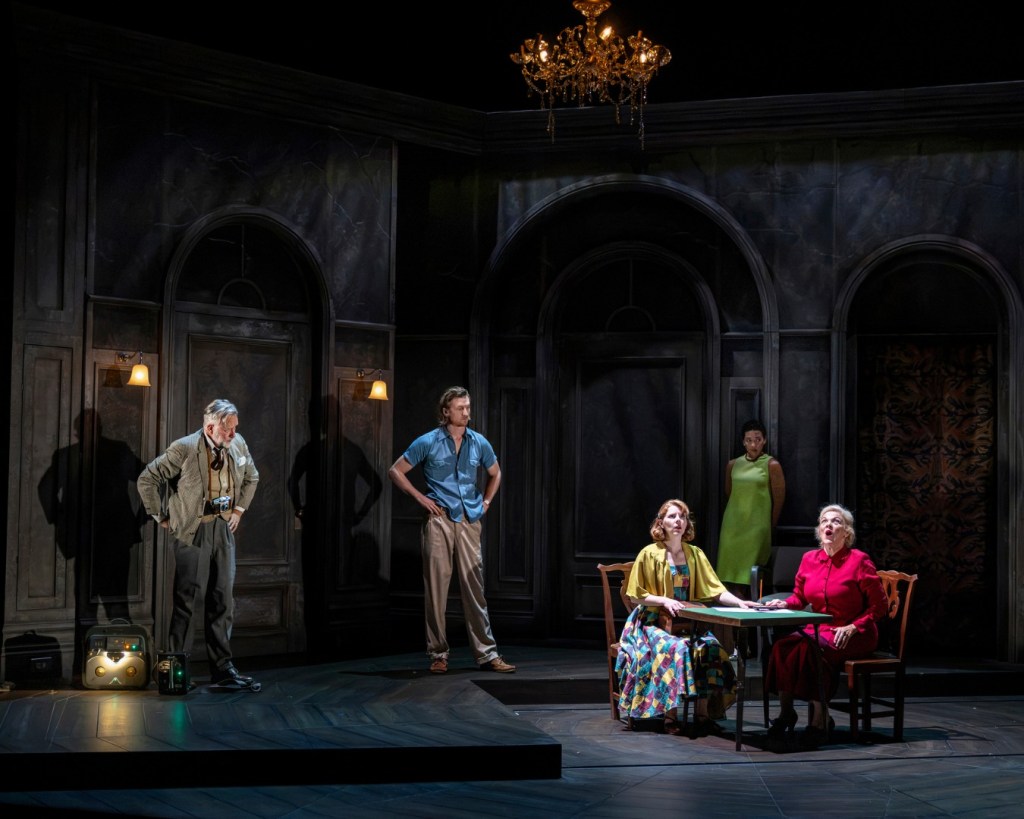
Just in time for Halloween, The Haunting of Hill House is playing at Manchester’s Palace Theatre this week, bringing plenty of scares to the city. Amid the production’s busy UK tour, I caught up with star Sophie Lenglinger to talk all things Hill House, from onstage scares to haunted dressing rooms.
It’s lovely to meet you. I loved the show, I saw it on Tuesday.
“Lovely! Oh, my god, I didn’t know you’ve seen it already.”
Yes, of course. I thought you were incredible!
“Thank you so much.”
So, The Haunting of Hill House has been adapted many times and reinvented on film, TV, and now for the stage. So, I wanted to ask what you think makes the story so special, and why do you think audiences can’t get enough?
“Yes, I think that’s a great question. I think, for me personally, what I thought when I first read the novel, because I hadn’t been familiar with the story, so I hadn’t seen any of the adaptations, so I came to it quite unknowing. And then once I read the novel, I mean, I was so excited to get started on it because the way that Shirley [Jackson] writes, it just draws you in. You’re very much in Eleanor’s psyche, and you’re very much in that sense in that house. And so I think it’s that kind of story where you really want to know what happens but you’re also kind of afraid of turning the page and seeing where the story will go.
“I think in terms of stage… There’s something about all being together. I think theatres, in some ways, can be quite scary anyway because they’re usually quite old buildings and there’s like darkness. People are whispering. You don’t know what’s going on, and in that way, I think it’s a great place to scare people with a story like this, and I wonder why people keep returning to it. I think it’s more to do with Eleanor’s fragility and being in that mind and having a sort-of distorted sense of reality and constantly questioning if this is what is actually happening? I think that’s quite intriguing, and that really draws people in.”
I think especially like being sat in the audience, there have been quite a few scary shows coming to Manchester recently, and it’s such a feeling in the audience of like, ‘We’re all in this together’. We’re all like looking around a bit, a bit spooked, like waiting for something.
“I’m glad. It’s great for the season.”
Do you have any time this week to celebrate Halloween, or are you too busy with the show?
“Well, I didn’t think to pack a costume. I might just draw some whiskers on my cheeks. We’ll see.”
The show has been touring since September, and so I was wondering, has there been a different feel this week, being Halloween week? Has the audience been a bit more, I don’t know, spooked?
“Actually, yeah, every venue is different, but the [Manchester] Palace is obviously the biggest venue that we’re playing. It’s the biggest one I’ve ever played, and the space actually makes it a bit more daunting, anyways. As I think as a performer, I thought that because it’s so large, it would be a bit less scary, but there is something about being able to see so far into the distance that makes it even freakier. So, I don’t know. I think it’s generally the change of season that has been quite lovely for the show to just, you know. see the seasons change and think, ‘Oh, maybe this is what it would have been like at Hill House’. You know, it’s kind of buried in the depths of the forest, and you get that leafy smell of autumn. I think it kind of informs the show in a really nice, lovely way. I think for audiences and us and for us actors as well.”
I think it’s perfect timing for the show. It’s terrifying for audiences being there, but has there been any point like in rehearsals or even on stage where something caught you a bit off guard? Obviously you know when everything’s coming, but has maybe a sound effect or something like ‘got’ you a little bit?
“There’s two things. One of them was in rehearsals. We did an exercise. It was almost like musical chairs, but not really. We were just walking around the space, and at some point we would have to sit down, and someone would have to scare us. Someone would have to shout or scream, but you never knew who was going to do it. And so we started the exercise. We were walking around, and then Martin, the director, said, ‘Okay, take a seat.’ And as I sat down, I thought to myself, ‘I wonder who’s going to be that.’ As I was thinking the thought, one of the other actors just screamed, and it was just completely because he left no space to breathe, and it just completely freaked everyone out, and it was like a real scare, and it was great. I loved it, and then after that, you know, you couldn’t top that honestly. So that was really scary for us because it was unexpected, and it was great to have that feeling and know what we can expect the audience to feel as well, what we hope they feel.
“And then there was another moment in Brighton last week where I was backstage, and I was waiting to go on, and then the door from the dressing room just kind of opened, kind of closed by itself, and I just thought, ‘I’m gonna get out of here, and I’m getting out of here right now. Who just came in here?’ So yeah, that freaked me out a little bit. But I mean, the sounds are great in the show, obviously. But I think I’ve gotten used to them now; that doesn’t scare me anymore.”
The sound effects and the projections are incredible in the show. It really brings the house to life. What is that like? Working with that in rehearsals, mapping out when the actual house moves, but through the projections?
“Well, I actually didn’t get to see that much of that because when we’re on stage, they were all working out there, and you know, I actually didn’t see a lot of the projections until we got into tech, and then sometimes I could sit outside in the auditorium and watch. But I thought they were great. I mean, I wasn’t that involved in obviously making them. I think they’re a great addition to the show, and they really, again, give it almost like more of a cinematic feel. I think what was nice as well is coordinating in that way as an ensemble. Where are the sounds coming from? Where do we look together? Like that was kind of like fun to work out together.”
One thing that really was important to me about the show was Eleanor and Theodora’s relationship. I thought your chemistry was amazing, and I don’t know if you heard in the audience, during those moments of intimacy, there were gasps around the audience. There’s such a vibrant queer scene in Manchester so I thought it was really cool to see that explored on stage, and then just the fluidity of Theodora’s character as there’s like a connection between her and Luke as well. What was that like developing those chemistries between the performers?
There’s such a vibrant queer scene in Manchester, so I thought it was really cool to see that explored on stage, and then just the fluidity of Theodora’s character as there’s like a connection between her and Luke as well. What was that like developing those chemistries between the performers?
“It was really lucky in the sense that I just loved working with Clancy [Ryan] and Robin [Morrissey] in that way, and I think Shirley again. Back to Shirley, she was just so ahead of her time writing a character like Theo. Even though we get to see her in the novel through Eleanor’s eyes, I think I had a great time kind of finding her mask first because I think she, like all the characters in a way, presents a version of herself to these people that she’s just met for the first time, and that version, I think, needs to be careless and free and draw people in, but I think that’s very much for her self-preservation and for her own safety.
“And so I thought it was great to start out with that mask and then find the moments in the play where that mask is slowly stripped away by what’s happening around her. And in that sense, when she does find that connection with Eleanor because I do think she cares about her. It’s also scary because I think she cares about her but is afraid to care for her. She doesn’t want that responsibility, and so I think finding those moments with Clancy where we get to have fun was really lovely. But then finding the moment and then exploring the moments where there’s an unwanted or unprecedented vulnerability. Yeah, it was scary in a way. I think it’s scary for Theodora.
“I think their relationship is really lovely, and I think it’s so sad that that there’s just this wall between them that I think the house is kind of built, like putting up as well, because I don’t think Theo feels safe enough to have a sort-of full-on relationship with someone, maybe ever. Who knows what happens after Hill House? And then what happens with Eleanor at the end of the play. Obviously, having that feeling of, ‘Have I just abandoned this person? Is this my responsibility after all?’ But I think at that point, her mask is back on, and she’s very much like, ‘No, you abandoned her. Mrs. Montague was your fault.’ I think again, it’s that thing of self-preservation with Theo.”
Where do you imagine she goes after Hill House? Do you think she goes back with her roommate and sorts it out?
“I think maybe there’s a thing in it when her clothes are destroyed. I imagine her having like a big elaborate wardrobe, and I imagine her walking out of or her roommate leaving her, and her packing up all their shared items and just leaving and making a big brand exit, and I think that when that’s destroyed, I think that’s a moment of realisation of ‘Oh, my clothes don’t matter’, like ‘What I have, what I’ve left behind, matters,’ you know?”
The Haunting of Hill House runs at Palace Theatre Manchester until October 31st (fittingly!) and tours the UK until November 21.