★★★☆☆
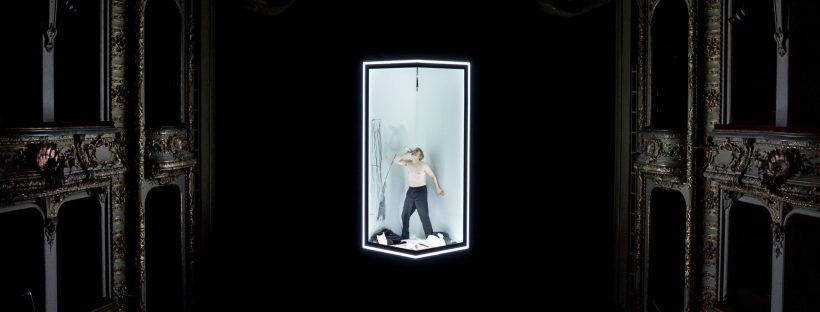
The Coronet Theatre, a Grade II listed theatre in Notting Hill, is a warm and unconventional theatre space. Wandering through the corridors and passing antique bookshelves, curios, and a fish tank, you feel more as if you have stepped into the living room of a wealthy eccentric than a London theatre bar. It is, therefore, a fitting venue to host this piece, a dramatisation of Oscar Wilde’s letter, De Profundis, which he wrote to ex-lover Lord Alfred “Bosie” Douglas from his cell in Reading Gaol while imprisoned for gross indecency. As you move from the pleasure and excess of the theatre bar into the auditorium which hosts a black box and cold, white light, you feel starkly the contrast between Wilde’s life before and during imprisonment. The stage design by Hansjörg Hartung, and lighting by Steffen Heinke, do well to reflect the bare confinement of Wilde’s cell.
The performance is a one-man show by the Berliner Ensemble, starring award-winning actor Jens Harzer, and performed in German with English surtitles. It is slightly unusual for us to hear Oscar Wilde, Irish writer and master of the English language, recited in German, but it speaks to the universality of the letter. Far from Wilde’s comedies of manners we’re more accustomed to seeing on London stages, it is a tortured monologue from an ex-lover who feels his soul has been damaged by a relationship. The text is phenomenal. The passion and candour with which Wilde writes is extremely compelling. It is a great baseboard from which to create a show — I feel I could have read the letter on paper in one sitting and still been engrossed.
While the theatre text is elaborate and embellished, the technical elements are simpler. The costume, by Elina Schnizler, is very effective. In the near-complete darkness through which Harzer’s Wilde enters his cell, his dinner jacket, with turned-up collar paired with the stillness of his body, seems almost to appear as a straitjacket. Naturally, as Wilde stands imprisoned in his box, we feel the injustice of his castigation. It is effective in doing so, albeit unadventurous; the text moves vividly through moments in Wilde’s life, it would perhaps have been more engaging to see this reflected in the staging, rather than remaining in the cell for the show’s 1 hour 50 runtime.
Harzer’s approach is tortured — we watch the actor shaking and sweating, falling into a kind of mania or nervous breakdown. At times, it is compelling to see his despair and hear his impassioned cries of ruination: “I had given you my life, and to gratify the lowest and most contemptible of all human passions, Hatred and Vanity and Greed, you had thrown it away. In less than three years you had entirely ruined me from every point of view.” At other times, this mania seems less natural. Wilde’s letter is over 50,000 words long, and while passionate and distressed, it is also structured and lucid. For instance, as Wilde writes the melancholic lines, “It is always twilight in one’s cell, as it is always midnight in one’s heart. And in the sphere of thought, no less than in the sphere of time, motion is no more,” our actor shakes and shouts, more animated than he has been before, in a way that is almost jarring.
As director Oliver Reese and dramaturg Johannes Nölting interpret the text, they take some creative license, making some ahistorical insertions such as the graphic depiction of self-harm. Of course, the text is theirs for interpretation. However, it turns Wilde’s thoughtful account of emotional abuse and broken-heartedness into the ravings of someone crazed. Near the end of the show, we see Harzer’s Wilde smear himself in a pitch-black paint. Against a backdrop of organ music, by Jörg Gollasch, he becomes a disturbed, ghost-like figure. Is this a fair depiction of the man who writes so lucidly and philosophically on the state of his own soul?
Nonetheless, the Berliner Ensemble prove Oscar Wilde’s letter to be an enduring force, a timeless recollection of love, hatred, philosophy, art, and injustice. One worth reading, or seeing, for yourself.
De Profundis runs at the Coronet Theatre, London until October 7 and transfers to the Berliner Ensemble, Berlin from October 31 to November 30.
Photo: Jorg Bruggemann

