★★★★★
There are few stories as enduring, or as devastating (‘…for never was a story of more woe than this of Juliet and her Romeo.’), as Shakespeare’s Romeo and Juliet. English National Ballet’s production, in Rudolf Nureyev’s celebrated 1977 staging, is a sumptuous reminder of why The
Bard’s tragedy continues to captivate audiences centuries after it was written.
Combining Sergei Prokofiev’s extraordinary score with evocative period design, accomplished dancing and genuinely affecting storytelling, this is an evening that makes you laugh, marvel, and,
ultimately, grieve.
Prokofiev’s music is indeed among the great achievements of twentieth-century ballet. Composed for a work first staged in 1938, the score moves from the imposing menace of the instantly recognisable ‘Dance of the Knights’ (currently trending on TikTok over cute pet videos) to passages of extraordinary tenderness, with restless rhythms, playful orchestration and sweeping
melodies reflecting the full emotional range of the story. It is music that can make a ballroom feel threatening, a stolen glance feel momentous and a final farewell almost unbearable.
Nureyev’s interpretation understands that the story is about considerably more than two young people falling in love: it is a portrait of a society trapped by inherited hatred, family honour and rigid social expectations. The lovers may be at the centre, but the people surrounding them are very much integral to the tragedy. Their rivalries, ambitions, loyalties and petty vanities create the world in which Romeo and Juliet’s happiness becomes all but impossible. The attention to the wider
society gives the ballet its dramatic depth. The story unfolds not simply through steps, but through gestures, expressions, glances and the relationships between characters. Even familiar episodes feel alive, with the audience able to follow the shifting emotions without a word being spoken.
The costumes are magnificent. Designed by Franca Squarciapino, they possess an authenticity that goes far beyond the usual theatrical suggestion of historical dress. The fabrics, silhouettes and intricate detailing establish a convincing Renaissance setting, with the richness of the aristocracy
contrasting against the more modest attire of the wider community. Some of these costumes could easily feature in a lavish period film without looking remotely out of place. What makes them so effective is that they never feel like mere decoration. The clothing establishes status, character and
allegiance, while its movement adds another dimension to the choreography. The result is
sumptuous but convincing, lending the production an almost cinematic realism. You don’t simply watch dancers dressed as Renaissance Italians but you make you feel as though you have stepped into their world.
The stage design is equally impressive. Ezio Frigerio’s backdrops, architectural details and carefully chosen props transform the Palace Theatre stage into a remarkably convincing Verona. Grand interiors and bustling public spaces give the story scale, while the more intimate settings allow the
emotional drama to take centre stage. The scenery is beautiful without overwhelming the dancers, and the changing visual atmosphere helps carry the audience from festive celebration towards impending catastrophe. There is a wonderful sense of place throughout. The stage never feels like
an empty space on which the choreography has been arranged; it feels inhabited, with a society operating beyond the immediate focus of the action. Together, the scenery, costumes and lighting create a world that is rich in historical detail and theatrical imagination. It is the kind of production
in which simply looking at the stage is a pleasure.
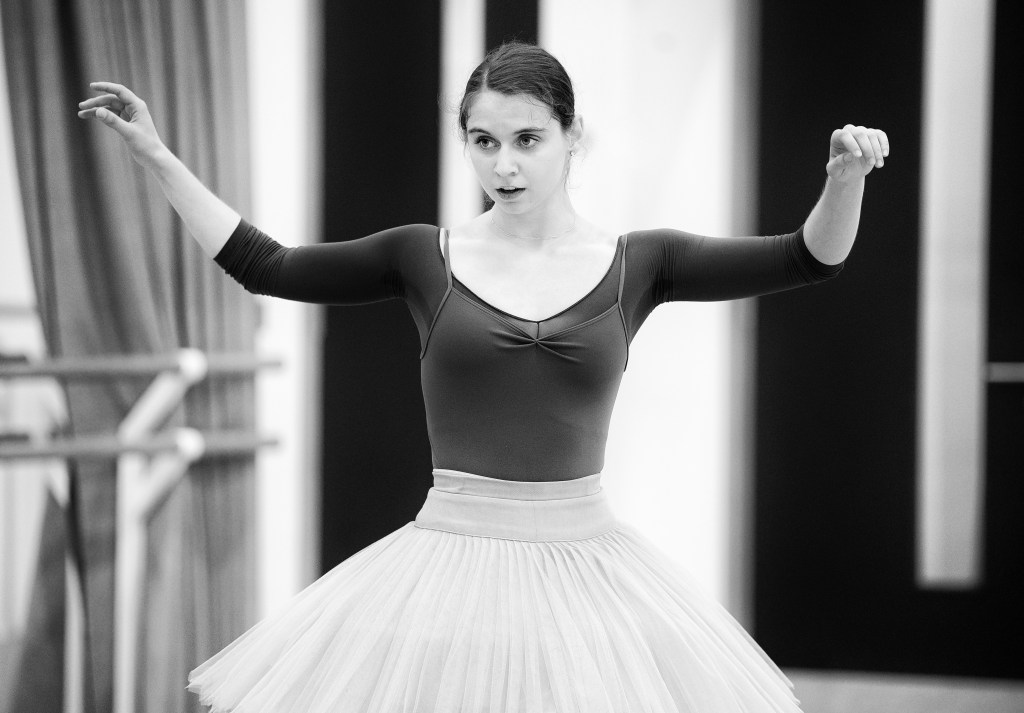
As Juliet, newly appointed Principal dancer Julia Conway gives the evening a compelling emotional
centre. Having interviewed Conway two weeks earlier, it was particularly rewarding to see her take on such an iconic role. Julia’s Juliet is not merely a romantic heroine swept along by events, but a young woman whose confidence, curiosity, and determination develop as the consequences of her choices become increasingly clear. Conway’s strength lies in the connection between her physical performance and her characterisation. Juliet’s youthful excitement gives way to a more profound emotional maturity, and Conway makes that transition feel organic rather than mechanical. There is a world of difference between executing a technically demanding sequence
and using movement to reveal what a character cannot say. At her best, she achieves the latter, allowing the emotion to emerge through the dancing rather than relying on theatrical gestures alone.
At times, however, Conway’s facial expressions veered towards overacting. While a degree of exaggeration is understandable in ballet, where performers must communicate with audiences
seated some distance from the stage, from a seat close to the front, these expressions occasionally felt too pronounced, drawing attention away from the subtler emotional nuances of her dancing. A slightly more restrained approach might have allowed the character’s inner life to emerge with
greater naturalness, trusting the movement itself to convey what Juliet is feeling.
Rentaro Nakaaki’s Romeo makes an engaging partner. The role demands a delicate balance: Romeo must be impetuous enough to propel the tragedy forward, yet tender enough to make his love believable. Nakaaki brings an appealing physicality to the part, and the partnership is most affecting when the dancers seem to respond instinctively to one another. In the intimate duets, a glance becomes an invitation, a lift an expression of trust, and an embrace conveys the lovers’ desperate wish to escape the world around them. These moments are central to the ballet’s success. The choreography asks the dancers to communicate attraction, vulnerability and growing intimacy while maintaining the technical control that classical ballet demands. When technique and dramatic
purpose become inseparable, the effect is wonderful. Nakaaki also commands the stage with a confidence that often draws the eye, even when he is not the focus of the choreography. Romeo is arguably the more physically demanding of the two principal roles, requiring considerable stamina,
athleticism, and explosive energy alongside the ability to convey emotional intensity through movement. Nakaaki meets these demands with assurance, combining physical power with moments of tenderness to create a compelling and vital presence throughout the evening.
Fabian Reimar’s Tybalt, meanwhile, supplies a formidable dose of menace. His physical presence and forceful characterisation make him an effective embodiment of the family pride and aggression that keep the feud alive. Tybalt is not simply an obstacle to the romance; he represents a social code in which backing down is a humiliation and violence becomes a means of defending one’s honour. His confrontations with Romeo therefore carry a significance that extends beyond personal animosity.
One of the production’s most enjoyable qualities, however, is its sense of humour. Some scenes genuinely prompt chuckles from the audience, thanks to the dancers’ wonderfully observed facial expressions and reactions. An exaggerated look of indignation, a flash of jealousy, or a
conspiratorial glance can communicate an entire personality in a split second. These moments feel spontaneous and human, providing welcome lightness without undermining the seriousness of the story. As such, the comedy makes the tragedy more effective. We are reminded that Verona is not populated solely by doomed lovers and murderous rivals, but by people who gossip, flirt, posture, and occasionally make fools of themselves. The social dances feel like glimpses of an actual community, and the characters become more recognisable as a result. When the mood eventually darkens, there is a real sense of something joyful being lost. Accordingly, Nureyev’s choreography is demanding in ways that go well beyond technical difficulty. The large ensemble scenes require not only stamina and coordination but a convincing collective identity. The dancers must establish
the social order of Verona through their movements, while the principal roles demand precise timing, expressive nuance and the ability to sustain a character across an emotionally exhausting evening. The contrasts are particularly effective. Formal, measured gestures convey status and
restraint; quicker, more agitated movements suggest hostility and impulsiveness; the expansive choreography of the lovers offers moments of apparent freedom from the rules imposed on them.
The confrontations, too, are more than spectacular displays of swordplay. They make the feud physically tangible, showing how violence has become so embedded in the characters’ lives that it is almost impossible to escape.
There is, nevertheless, room for improvement. English National Ballet’s individual dancers are genuinely world class, but the ensemble does not always possess the precision and uniformity associated with established powerhouses such as the Bolshoi Ballet, Paris Opera Ballet, or New York City Ballet. Some group passages could be tighter in their timing, lines, and spacing, and the occasional lack of synchronisation takes a little of the polish off the larger stage pictures. In a production whose impact depends partly on the collective precision of its choreography, those details matter. That said, this is a criticism of the overall finish rather than the quality of the leading
performers. The individual artistry is often exceptional, and the dramatic commitment is unmistakable. Technical uniformity is one measure of a ballet company, but it is not the only one. Here, the strength of the principal dancers, the richness of the staging and the clarity of the
storytelling make for a highly rewarding theatrical experience.
One sequence that particularly stands out is the episode in which Friar Laurence explains his plan to Juliet. Rather than leaving the audience to absorb the scheme through ‘dialogue’ alone, the staging allows us to see it playing out in the background. It is a clever, beautifully judged piece of theatrical
storytelling: the plan becomes visible, the moving parts fall into place, and the audience can appreciate both its ingenuity and its terrible fragility. The effect is to create tension on two levels. We understand what the characters hope to achieve, yet we are acutely aware of how much depends
on circumstances unfolding exactly as intended. Watching the plan take shape makes its potential consequences feel immediate, and the knowledge that even a small misunderstanding could prove fatal becomes increasingly unsettling. It is an excellent example of how ballet can communicate complicated narrative information through movement and stagecraft, without sacrificing
momentum.
And then there is the finale. The final scenes are devastating, not because they rely on spectacle alone, but because the
production has made us care so deeply about the world that is about to be destroyed. Conway’s Juliet and Nakaaki’s Romeo are not abstract symbols of tragic love; they are recognisable young people whose hopes have seemed, for a brief moment, entirely possible. Their loss feels personal. Prokofiev’s music intensifies the anguish, but the emotional weight comes from the dancers’ physical expression of shock, desperation, and grief. Gestures that earlier conveyed tenderness acquire a terrible new meaning, while the stillness and vulnerability of the final moments provide a stark contrast to the bustling energy of the earlier scenes. The tragedy is both grand in scale and painfully intimate. What makes the ending so powerful is its inevitability. The family feud, the impulsive decisions, the failures of communication, and the fragile plan have all been buildingntowards this moment. We know how the story ends, yet that knowledge does nothing to diminish
the impact. If anything, it makes the final sequence more painful because we have spent the evening watching the catastrophe approach while hoping, against our better judgement, that things might somehow turn out differently.
Under Artistic Director Aaron S. Watkin, English National Ballet has delivered a production that brings together the essential elements of great classical ballet: unforgettable music, dramatically intelligent choreography, exquisite costumes, evocative scenery, and individual performances of real distinction. Ben Pope conducts the score with the emotional breadth this story demands, allowing its shifts between romance, comedy, menace and tragedy to shape the evening. Most
importantly, this Romeo and Juliet understands that a great ballet must be more than a succession of
beautiful movements. It must make us believe in the characters, invest in their happiness, and feel the full force of their downfall. This one does exactly that. It makes you smile at human absurdity, marvel at the artistry on stage, and finally sit with the terrible sadness of a tragedy that remains as relevant today as ever.