Cinderella has been done so many times before, and it has been reimagined many of those times, from a Black Cinderella to Bad Cinderella. But one of the most radical reimaginings is Matthew Bourne’s Cinderella, which uses the majestic music from Sergei Prokofiev’s ballet but relocates the action to the London Blitz, with the Prince replaced with a pilot.
Matthew Bourne relocated Cinderella to the 1940 London Blitz primarily because Sergei Prokofiev composed the score during World War II, and Bourne felt its dark, urgent undertones (especially the ticking-bomb tension of the midnight clock sequence) mirrored the anxieties of war rather than a lighthearted royal palace. Setting the fairy tale in WWII London gave the whirlwind romance higher stakes whilst also serving as a personal tribute to Bourne’s parents and grandparents who lived through the Blitz, indulging his love for 1940s Hollywood escapism, and anchoring the “royal ball” in the real-life 1941 bombing of London’s famous Café de Paris nightclub.
Amid air-raid silents, blackout coniditions, and rubble, an optimistic Cinderella dreams of old Hollywood glamour whilst living under the thumb of her unkind stepmother, Sybil (a deliciously devilish Michela Meazza), her disabled father, Robert (Benjamin Barlow Bazeley), and an extended stepfamily, which consists not only of stepsisters, Irene and Vivien (Carla Contini and Molly Shaw-Donwie), but also stepbrothers, Malcolm, Vernon and Elliott (Tom Barnes Standing, Matthew Potulski, and Louis Harris). There are also boyfriends, Buster and Stan (Woody Freeman and Mark Austin), and girlfriends, Betty and Judy (Molly Shaw-Downie and Isabella).
In typical Bourne fashion, queer love and history are acknowledged, with one of the stepbrothers falling in love with a man but having to be quiet about it, which felt especially poignant in Manchester, knowing how wartime hero Alan Turing was punished for his sexuality, leading to his suicide – something which these characters do not yet know, creating a sense of dramatic irony.
Cinderella meets Harry, a dashing young RAF pilot who is dealing with the trauma of war. I was delighted to see that Rory Macleod was playing the male lead on press night, as he is always so striking onstage and certainly one of my favourite dancers in the country and one of the most dazzling dancers at New Adventures, alongside Cordelia Braithwaite, Paris Fitzpatrick, and, of course, the most mesmerising Ashley Shaw.
Harry’s friends, Dick and Tom (yes, Tom, Dick and Harry!), were played by Matthew Petty and Adam Davies.
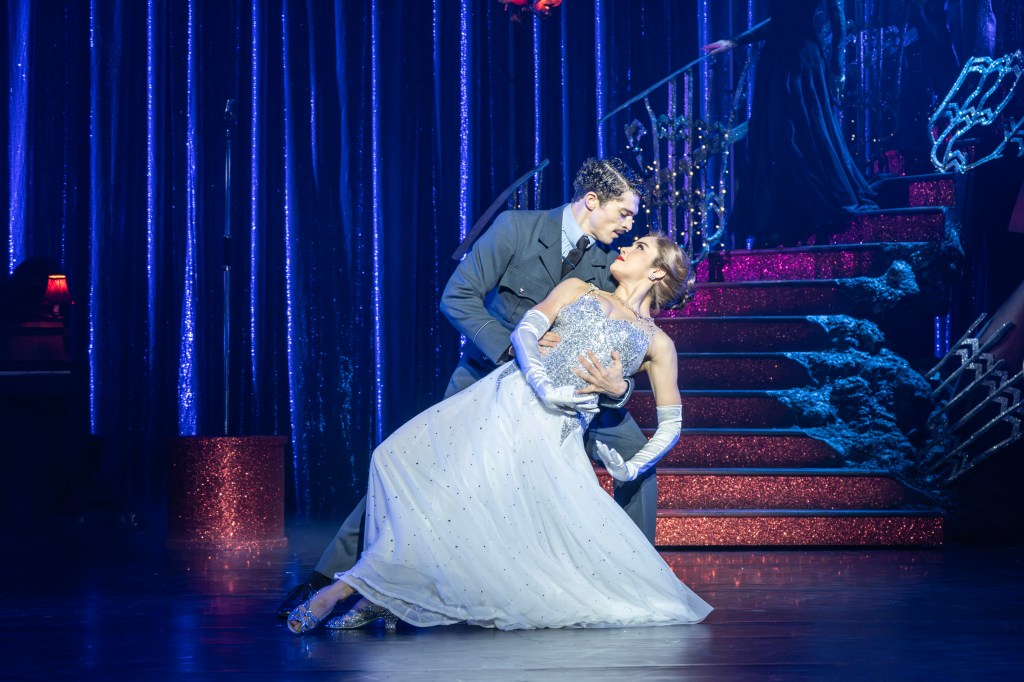
The fairy godmother has been replaced with an angel, a mysterious male guardian, who guides Cinderella. In a pivotal scene inspired by the Café de Paris, the angel rewinds time to restore a bombed venue into a glamorous ballroom where Cinderella and Harry connect before the realities of the Blitz pull them apart.
Bourne’s rewriting of the story is very imagining and innovative, and whilst I loved how he has rewritten and recontextualised the overdone story, some people may mourn the simple, comforting magic of a traditional Cinderella. Whilst ballet can be difficult to follow, a familiar story like Cinderella does not usually require too much from the audience, but Bourne departs heavily from the original story, so some people may get a little lost in the narrative.
One cannot help but roll their eyes at Cinderella a little, who seems not to have her priorities right as the city crumbles around her, but it is true that people tried really hard to live their lives as normal as possible amidst all that horror – including going to parties for escapism and normality.
Lez Brotherston’s set is absolutely sublime. The stage is lined with bricked walls with blown-out windows, which double as wings, ensuring that the reality of war is always felt. Even when the characters are seemingly safe inside luscious homes or dancing away at glamorous parties, they are surrounded by war. The back wall is made up of a screen though I did not realise it was a screen until it started moving. In an incredibly slick scene change, Cinderella exited through the door at the back, which span around, bringing her back onstage, with Duncan McLean’s video designs suddenly changing, with performers filling the stage and lighting the auditorium with torches. But the most memorable part of the staging is, of course, when a bomb goes off and the entire set explodes.
As with any New Adventures production, Brotherston’s costumes are to die for. They are historically accurate but with a slight modern edge. In a piece with no speaking or singing, every single aspect of design becomes very important, with Neil Austin successfully capturing every emotion embedded in the libretto, whilst Paul Groothuis’ sound design helps transport the audience to the Blitz.
Matthew Bourne’s choreography is celebrated for doing away with traditional, rigid ballet vocabulary and instead creating a play without words (also the name of one of his shows which he is reviving next year!). Whilst his choreography in Cinderella is not quite as striking and technical as it is in some of his other shows (the first scene feels like more running around than dancing), it works for this production. There is a seamless blend of classical ballet, contemporary dance, 1940s social styles, and theatrical storytelling. There is inventive prop and partner work, and excellent use of physical comedy, including a tender, imaginative duet with a wheeled dressmaker’s mannequin dressed in an RAF uniform, a pas de deux incorporating Cinderella’s father’s wheelchair, and slapstick “drunk dancing” where the ensemble uses each other’s bodies for support. There are also sweeping romantic duets: the pas de deux between Cinderella and Harry are fluid, emotional, and intimate, conveying their whirlwind wartime romance entirely through physical connection – in contrast with the sharp, angular ensemble numbers.
Matthew Bourne’s Cinderella is a fresh, imaginative retelling of the most famous love story of all.
Matthew Bourne’s Cinderella runs at Lowry (Lyric Theatre) until November 28 2026 and tours the UK until May 8 2027.
Photo: Johan Persson